
What is Staff Augmentation? Scaling with Global Talent


In this article
- Staff augmentation, defined (the useful version)
- How staff augmentation actually works
- The types of staff augmentation (and the one that matters)
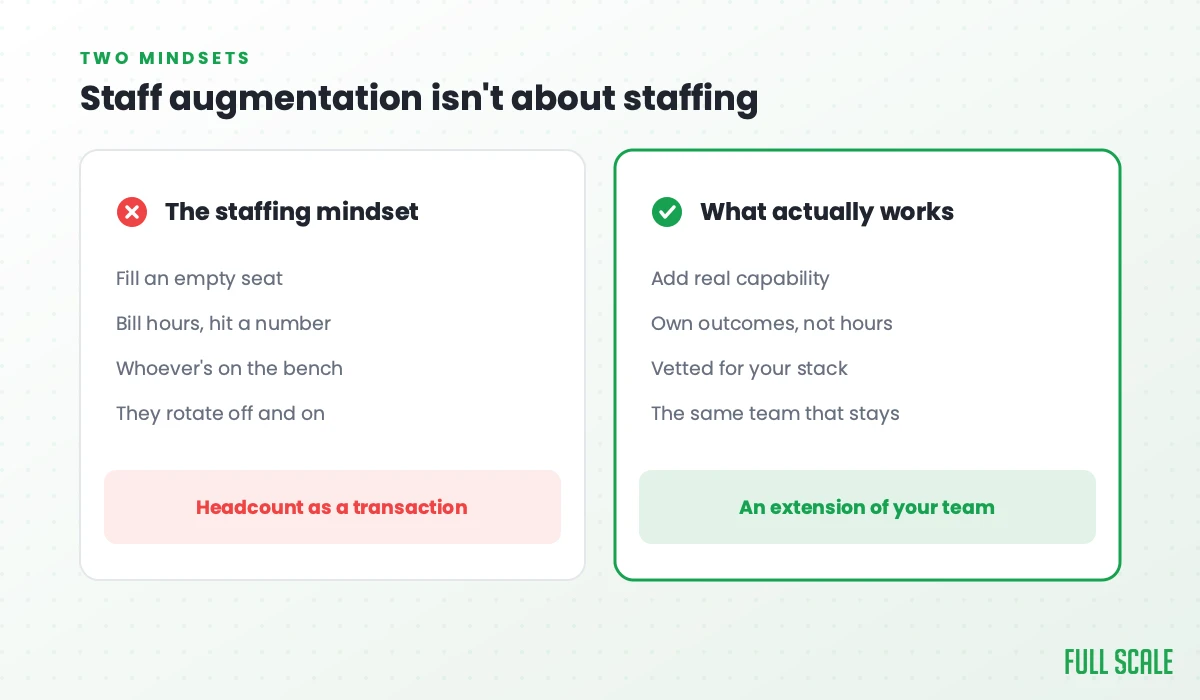
- Why staff augmentation isn’t really about staffing
- Where global talent fits the equation
- When staff augmentation is the right call (and when it isn’t)
- How to do staff augmentation right
- FAQ
- The bottom line
Most engineering leaders find out about staff augmentation the same way: their local hiring pipeline isn’t keeping up, and someone in a Slack DM mentions they’ve been using developers from the Philippines for two years and it’s been the best decision they’ve made all year. Once you understand the model, the real work is running it well, and that comes down to a few staff augmentation best practices. If rate is the deciding factor for you, read how IT staff augmentation pricing actually works before you negotiate a vendor down. Before anyone starts, you sign a staff augmentation contract that spells out payment, IP ownership, and how you cancel.
The term is everywhere right now. Toptal sells it, Turing sells it, every offshore development shop on the planet has a “staff augmentation services” page. It sits inside an enormous industry, too: US staffing companies hired 12.7 million temporary and contract workers in 2023, per the American Staffing Association. Most of the explanations get the definition half-right, and the version that actually works is more specific. If you’re sizing up where to find that talent, I compared Toptal vs Upwork for exactly this decision. And if you are checking Toptal’s reputation before you commit, I reviewed that too. It is also how teams reach scarce specialists they cannot hire locally, from AI engineers to the VR and XR developers behind immersive products. Lately the same question arrives wrapped in AI, where AI staff augmentation can mean three very different things depending on who is asking.
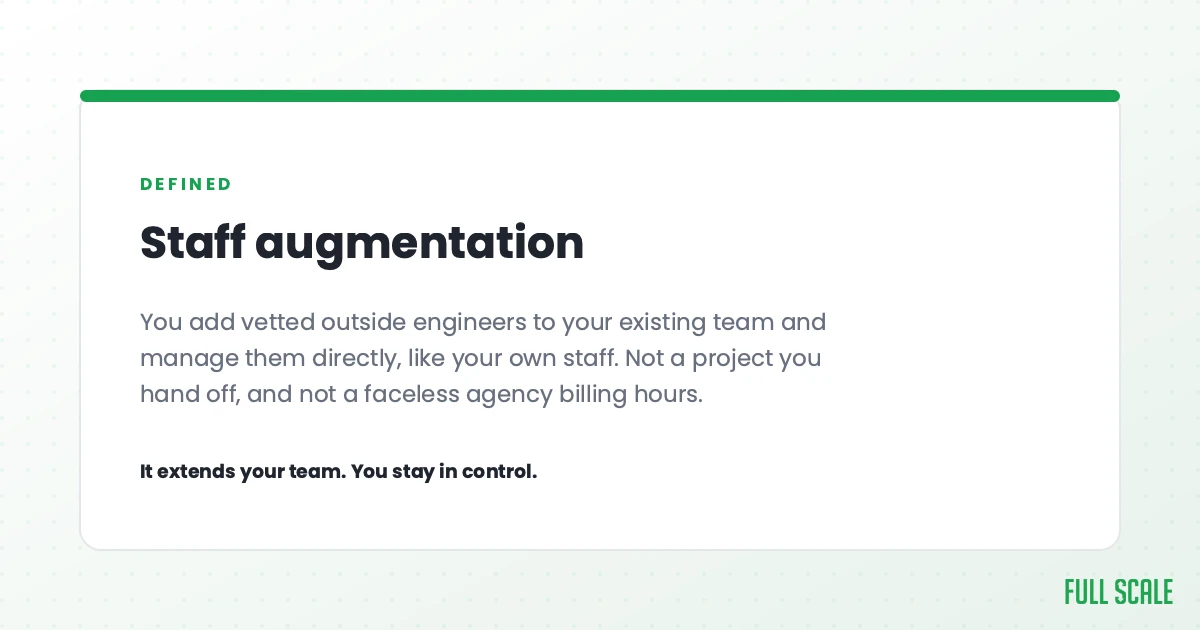
Staff augmentation is a staffing model where you hire external developers, usually through a partner, to work as part of your in-house engineering team. They take direction from your leads, sit in your standups, and ship into your codebase, but they’re employed by the partner instead of you.
That’s the textbook definition. It’s correct, and it’s missing the most important word: long-term. We’ll get to that. It is why we frame outsourcing the backend as a team decision, not a project one.
There is also a practical employment choice underneath all of this, namely whether to bring developers on through an employer of record or a staffing agency, and the retention gap between the two is wider than most teams expect.
Staff augmentation, defined (the useful version)
Most publishers stop at the textbook version. The staff augmentation meaning that matters in practice comes down to the management relationship, and I’ve sat on both sides of it, as the CTO buying augmented developers and the founder of a company that provides them.
The defining feature of staff augmentation is the direct relationship between you and the developer. You manage day-to-day work. You assign tickets, run the standups, set the standards, and own the code review. The partner is in the background handling HR, payroll, benefits, vetting, equipment, and developer retention. Pricing is time and materials, billed hourly or monthly. I go deeper on how that direct relationship actually works day to day, including what the vendor still handles in the background.
It’s worth saying what staff augmentation is not, because most of the confusion in the search results comes from publishers who blur these lines, the same ones who never quite explain the difference between resource and staff augmentation. It’s not project outsourcing, where a vendor takes a defined scope, manages their own team, and delivers an outcome. It’s not software consulting, where an outside firm hands you an opinion and leaves. The freelance marketplace model is something different again, because you’re the one sourcing, contracting, and managing each person yourself. The same hands-on burden comes with developer hiring marketplaces like Toptal and Turing, where you still manage each person yourself. It is a different model from the talent platforms, and how Toptal and Gigster compare to a dedicated team is worth a look before you pick one.
How staff augmentation actually works
The mechanics are simple, but most companies skip a step they shouldn’t. Here’s the five-step process when it’s done right:
- You define the role. Skills, seniority, stack, team you’re augmenting. The clearer this is, the faster step two goes.
- The partner sources and vets candidates. Resumes, technical interviews, English fluency screens, sometimes a coding exercise. The partner’s job is to deliver a short list, not a single name.
- You interview the finalists. This is the part most companies skip. Don’t. You’re hiring someone who’ll work on your codebase for years. The partner can vet skill, but only you can vet fit.
- Integration. Slack, GitHub, calendar invites, standups, the same onboarding plan you’d run for a local hire. If you’re treating them like a separate team, you’ve already lost the upside.
- Day-to-day work. Your leads assign the tasks, your code review process applies, and your engineering standards win. When it’s working, you forget the developers aren’t on your payroll.
SOTA Cloud, a client of ours that builds cloud dental imaging software, is a good example of what that vetting step is worth. Their co-founder and CTO, Dustin Johnson, runs engineering hiring with a one-person HR department, so pre-vetted shortlists were the difference between filling roles and burning his senior developers’ time on resume screens. The engineers he brought on became, in his words, top performers in the company, even relative to his US-based team. The full story is in the SOTA Cloud case study.
Behind that, the partner is doing the operational work that doesn’t show up in a Slack thread: paying people, providing benefits, replacing anyone who leaves, keeping equipment running. That’s the lift you don’t have to absorb. It’s also why the model is faster than local hiring. At Full Scale we typically have a vetted developer in your standup inside 14 days. Two to three weeks is the realistic range across roles and stacks. Staff augmentation is only one of the channels worth weighing, and which Toptal alternative fits depends on what you are trying to build.
A note on what the partner is not doing: they aren’t your CTO. They aren’t your architect. You always need technical leadership in-house. The partner provides developers. The direction has to come from you.
The types of staff augmentation (and the one that matters)
Every provider slices the model into types. Short-term augmentation covers a sprint, a deadline, or a sudden absence. Long-term augmentation embeds developers in your team for ongoing product work. Then there’s the location axis: onshore, nearshore, or offshore, depending on where the developers sit. And project-based augmentation, where you staff a defined initiative and wind it down after.
The labels are fine. They also bury the real decision. Where the developer sits matters far less than how long they’ll be on your team. Short-term augmentation is contracting with a better name, and it gives up the compounding upside that makes the model worth using. Offshore staff augmentation on a long-term team is the version where the talent pool, the cost math, and the institutional knowledge all stack in your favor. That’s the type the rest of this post is about.
Why staff augmentation isn’t really about staffing
Here’s where the textbook definition falls apart.
Read any of the top ranking pages on this topic and you’ll see the same framing: “responding to short-term demand increases,” “supporting time-limited projects,” “addressing specialized skill gaps.” None of that is wrong, but it’s also not why the model exists for the companies that get the most out of it.
We aren’t in this for some 3-month project.
The version of staff augmentation that works is built on a long-term team. Both sides commit. You’re not borrowing developers for a sprint, you’re hiring engineers who are going to be part of your product for the next few years. Short-term staff augmentation is barely distinguishable from contracting and it gives up most of the benefits of staff augmentation before you start.
What I learned at Stackify
I avoided offshore development for the first decade of my career. Every CTO I knew had a horror story: language barriers, late-night meetings, code that needed to be rewritten, project managers in the way. The conventional wisdom was that offshore was a pain in the neck and you were better off doing the work yourself.
A friend changed my mind. He had developers in the Philippines and the work was good, and I already had personal connections to Filipinos from before any of this. They were the nicest people I’d ever met, and their English was impeccable.
We opened a small office in 2018 to scale Stackify. The team grew slowly because we were treating them like real hires, not contractors. By the time we sold Stackify in 2021, those developers had been there for three years and knew the codebase as well as anyone in Kansas City. It was a big key to the success of the company and our eventual exit.
The setup worked so well that other founders started asking for access. That accidental business turned into Full Scale. We hired 100 developers in our first year.
Hire talent to work directly for you on a long-term basis. Don’t hire them just for a project. That’s the lesson I learned the hard way and it’s the spine of how we work with clients today. I wrote about it in more depth in the newsletter if you want the full story. What’s changed since is worth its own read too, in our 2026 staff augmentation trends breakdown.
What changes once you commit to long-term
Everything downstream of the staffing decision changes once you commit to long-term. You invest in onboarding instead of placement, you give context instead of tickets, you include the developers in roadmap discussions instead of just sprint work, and you let them push back on bad requirements the same way you’d let a local hire push back. This is the ownership argument I make in Product Driven: teams that own a product outperform teams that rent tickets, and that holds whether the engineers are in Kansas City or across the Philippines. The thing labeled “staff augmentation” stops looking like a contracting arrangement and starts looking like a team built with developers who happen to live somewhere else.
Staff augmentation is the right way.
Where global talent fits the equation
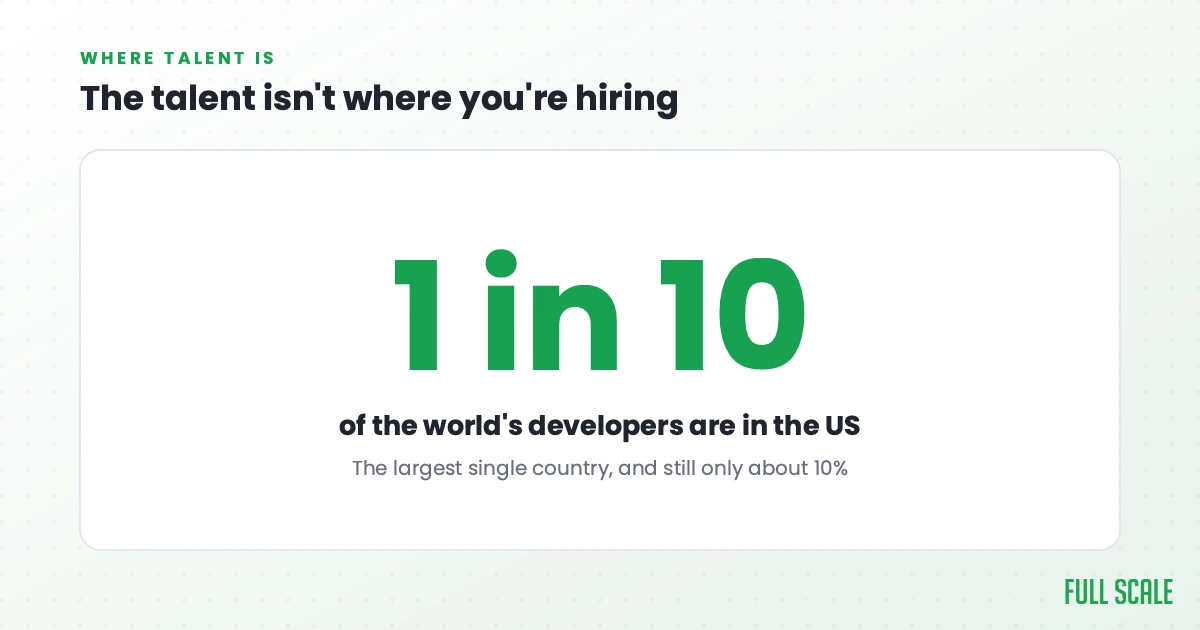
About 90 percent of software developers don’t live in the United States. That’s not a Full Scale stat. GitHub’s Octoverse data shows the US is the single largest developer country and still only about one in ten of the world’s developers, and it’s been roughly true for years. US tech voluntary turnover sits at 13 to 15 percent annually per BLS JOLTS data. The local talent math is unforgiving even when you can find people.
Staff augmentation across borders is how engineering leaders close the gap. It’s also where most of the cost advantage comes from, which is worth a short detour.
The cost is real, but it’s not why
Senior developers in the Philippines (or LATAM, or Eastern Europe before 2022) typically cost 50 to 70 percent less than equivalent US rates. Same skill level, same seniority, different rent. The gap comes from cost of living, and any framing that treats global rates as a quality discount is selling you something. Offshoring purely to chase the lowest rate has a name. I call it cheapshoring, and it’s how companies recreate every offshore horror story they were warned about. The cost difference is a benefit, not the reason to do staff augmentation. The real reason is the talent pool, and the cost is what lets the math work for a growing company that would otherwise blow through its engineering budget hiring locally.
If your team works well remotely, it will work well globally, too.
Why the Philippines, specifically
We chose the Philippines for Full Scale for a few specific reasons:
- Strong English fluency. Better, in my experience, than most of Latin America.
- US business culture overlap. The Philippines has 50 years of close business ties with the US, and it shows in how engineers communicate.
- Time zone overlap that actually works. With a Philippines team taking an evening shift, you get a typical four hours of real-time overlap with US business hours.
- The 14-hour time zone difference doubles as on-call coverage. While your local team is asleep, the Philippines team is heads-down on the work that needs handoff before morning.
The depth of the talent pool is the part most people underestimate. The Philippine IT-BPM industry employed about 1.8 million people and produced roughly $40 billion in export revenue in 2025, per IBPAP figures. That scale is a big part of why we hire developers in the Philippines instead of spreading thin across five countries.
I’ve hired developers in Russia (2012, before the war), Latin America (Uruguay), and the Philippines. Each had its strengths. The Philippines became Full Scale’s base because the combination of English, culture, time zone, and cost was hard to beat. If you are shopping around, I put together a rundown of staff augmentation companies in the Philippines, tagged by whether they actually run this model or a project-based one.
When staff augmentation is the right call (and when it isn’t)
This is the section the rest of the SERP refuses to write honestly, because most publishers tilt toward what they sell. Here’s the actual decision.
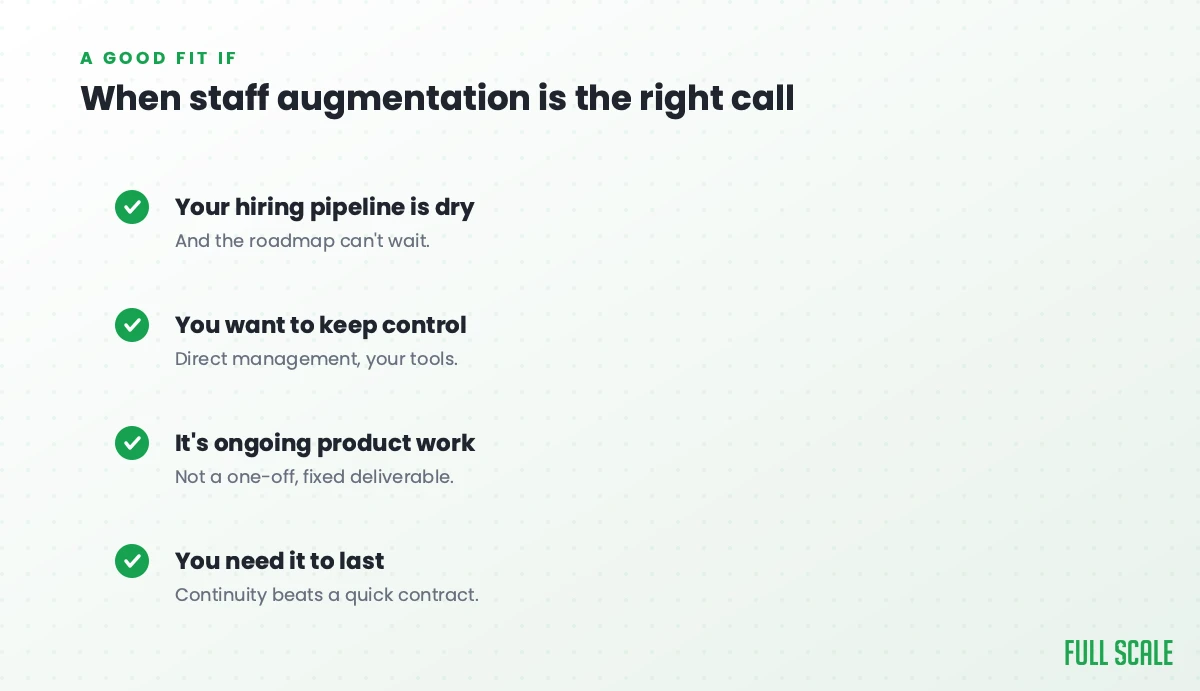
Staff augmentation is the right call when you have engineering leadership in-house, you’re building a product that will keep getting developed for years, your roadmap shifts quarter to quarter, and you need institutional knowledge to stay with the team. If those things describe you, the model fits.
It is not the right call in two situations. The first is scoped, statement-of-work (SOW) projects you’ll never need to touch again, things like a WordPress build, a one-time integration, or a specialist project where you don’t need an ongoing person on that technology. I’ve outsourced WordPress builds myself, and I outsourced an Elasticsearch project at one point. Both were the right call, and neither needed a long-term team. I go deeper on exactly when a SOW beats staff augmentation, and when it does not, in staff augmentation vs sow.
The second situation is companies without any in-house engineering leadership. If you don’t have a CTO or technical lead to direct the work, staff augmentation just hands you developers without an answer to “who tells them what to build.” What you need there is a vendor that owns the outcome.
Here’s how the staffing options actually compare:
| Dimension | Staff augmentation | Project outsourcing | Consulting | Traditional hire |
|---|---|---|---|---|
| Who manages the work | You | Vendor | Vendor | You |
| Pricing model | Time and materials | Fixed bid or milestone | Time and materials | Salary |
| Best for | Long-term product work | Scoped (SOW) projects | Strategic advice | Permanent core team |
| Speed to start | 2-3 weeks | 4-8 weeks | 1-2 weeks | 2-4 months |
| Commitment | Month-to-month | Project duration | Engagement | Permanent |
| Where IP sits | Yours | Yours (per contract) | N/A | Yours |
One model the table leaves out is managed services, where a provider takes over an entire function and answers to a service-level agreement instead of your engineering leads. From a distance it looks like staff augmentation. Up close it behaves like outsourcing with a subscription. I compared staff augmentation and managed services in a separate post if that’s the decision you’re weighing.
If the work outlives the contract, you want staff augmentation. If the work ends with the deliverable, you want outsourcing. For a deeper version of this argument, I wrote a full piece on staff augmentation vs. outsourcing.
How to do staff augmentation right
I’ve watched offshore development work and I’ve watched it fail. The pattern is consistent enough that I usually point to three things that have to be true. Picking the right staff augmentation company is its own decision, and I wrote about that separately. These three are about how you run the engagement once you’ve picked one.
- Location matters. I’ve hired in Russia, Latin America, and the Philippines. I’ve avoided India and I’d be lying if I said it was random, because most of the offshore horror stories I hear from other CTOs originated from Indian engagements. It’s not a rule, but it’s a pattern. Pick your region with eyes open.
- Teams, not projects. This is the same point as before, but it’s worth saying again from a practitioner angle. Most offshore collaboration fails because people simply hand a bunch of requirements over to an outsourcing firm. Then, they expect to get back a successful project. That model doesn’t work. The model that works is teams: long-term engineers committed to your product, on both sides of the agreement.
- Team structure. Don’t put offshore developers in a separate silo. Don’t have a “Philippines team” and a “US team.” Have one engineering org with developers in two cities. The best version I’ve seen has local engineering leads managing hybrid teams of US and offshore developers, with shared standups, shared standards, and shared roadmaps.
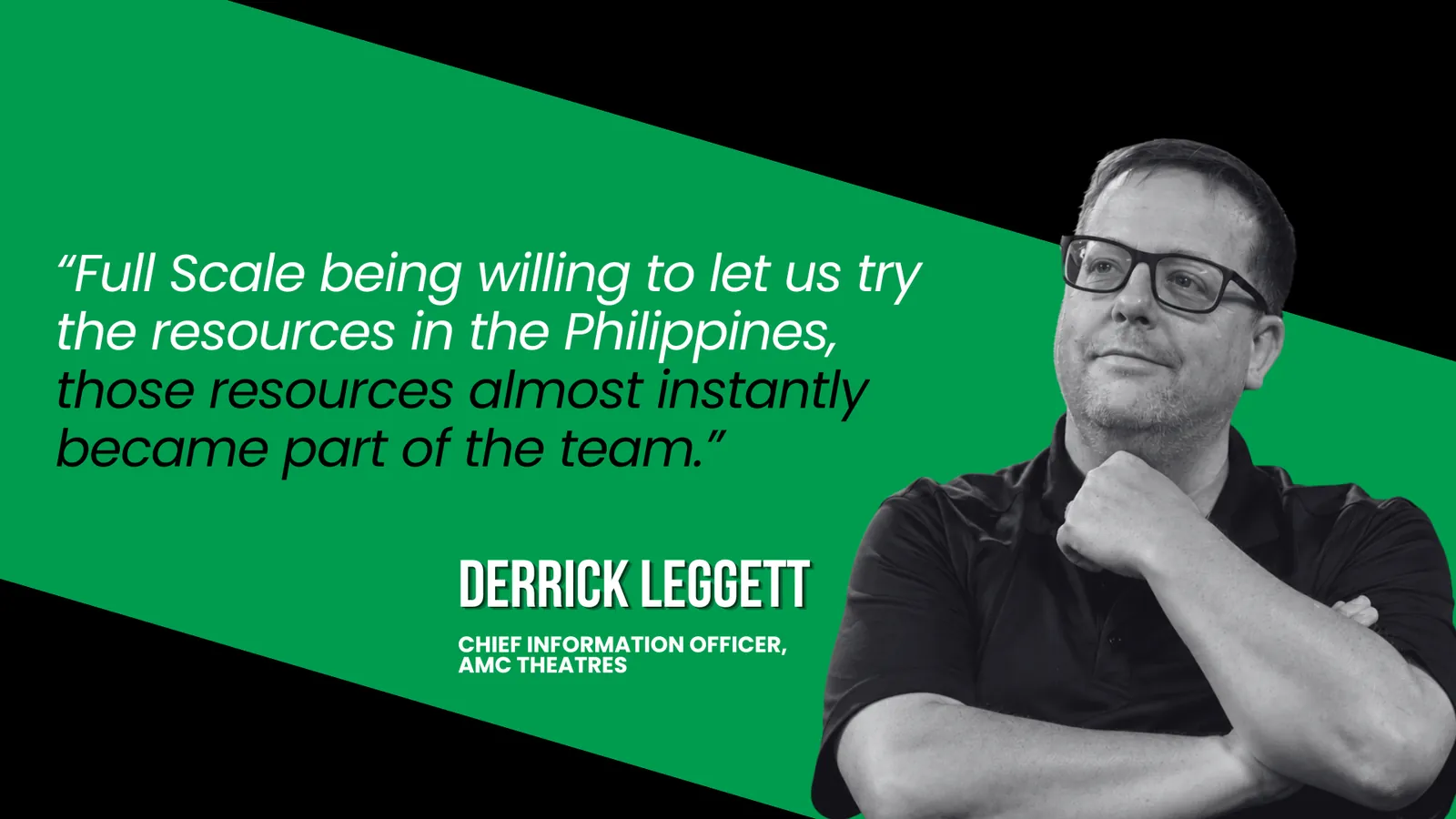
That third point isn’t theoretical. AMC Theatres runs exactly this structure, with Full Scale engineers working as part of one integrated global engineering org rather than a separate offshore silo. Their CIO, Derrick Leggett, talks about why integrated global teams replaced traditional outsourcing for them in the AMC Theatres case study.
A short note on the people side: most of the resistance to staff augmentation comes from past bad experiences with project outsourcing, not from staff augmentation done right. When I’ve talked to engineering managers who are skeptical, nine times out of ten it traces back to a fixed-bid project in 2014 that went sideways. Transparent communication with your existing team about what you’re doing and why matters more than the staffing model itself. I wrote about how to have that conversation in a separate post.
FAQ
What is IT staff augmentation?
IT staff augmentation is the same model applied to technology roles: you bring in external engineers, QA, or DevOps through a partner and run them as part of your own team, under your own leads. The “IT” just tells you the work is technical. Most people asking mean software development staff augmentation specifically, which is the version we run.
What is the difference between staff augmentation and outsourcing?
Staff augmentation puts external developers on your team under your management. Outsourcing hands a defined project to a vendor who manages the work and delivers an outcome. Staff augmentation is for long-term product work where you retain control. Outsourcing is for scoped deliverables where you want a fixed result. We covered this in depth in staff augmentation vs. outsourcing.
How does staff augmentation work in practice?
You define the role you need, the partner sources and vets candidates, and you interview the finalists. That vetting step is the whole ballgame, and it is not something a BPO’s hiring engine is built to do well. Selected developers then integrate into your team’s Slack, GitHub, standups, and code review process. Your leads direct their work day to day while the partner handles payroll, benefits, equipment, and developer retention. Typical timeline from kickoff to a developer joining your standup is two to three weeks.
How much does staff augmentation cost?
Senior developers in the Philippines, LATAM, or Eastern Europe typically run 50 to 70 percent less than equivalent US rates. The gap is cost of living, and it says nothing about skill. Pricing is a time-and-materials hourly or monthly rate billed by the partner, and specific rates vary by stack, seniority, and region. I broke down the full math in staff augmentation cost. The cost difference is a benefit, but the talent pool is the actual reason to use the model.
Is staff augmentation the same as offshore development?
Not quite. Staff augmentation is a staffing model, while offshore is a location decision, and you can do staff augmentation with developers in the US, in your time zone, or anywhere else. Most of the practical conversations involve offshore or nearshore developers because that’s where the talent and cost advantages are. About 90 percent of software developers don’t live in the US, per GitHub’s Octoverse data.
When should I NOT use staff augmentation?
There are two situations. First, scoped statement-of-work projects you’ll never need to touch again: a WordPress build, a one-time integration, a specialist project where you don’t need an ongoing person on that technology. Outsource those. Second, companies without any in-house engineering leadership. If you don’t have a CTO or technical lead to direct the developers, you’re better served by a vendor that owns the outcome.
The bottom line
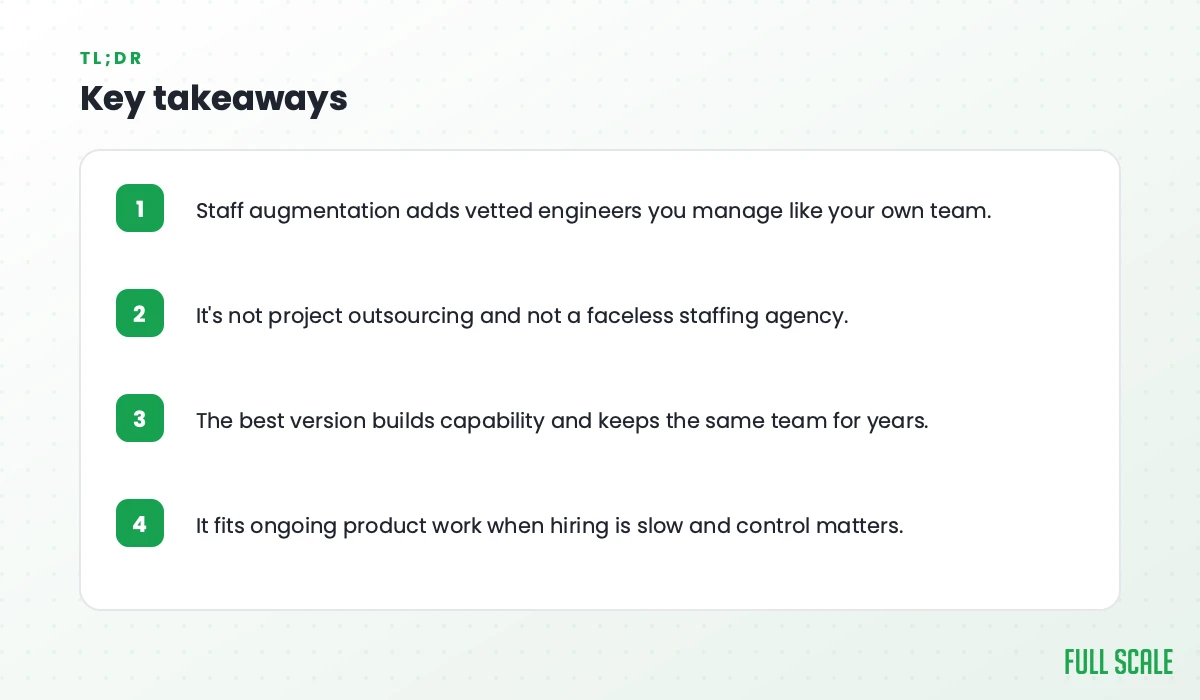
Hire talent to work directly for you on a long-term basis, and don’t hire them just for a project. Everything else in this post is detail. When you’re ready to act on it, what a legitimate proposal looks like is the next thing to get right. The version of staff augmentation that works is built on a long-term team, and that team can live anywhere in the world.
Looking to scale with global talent?
We’ve helped 200+ tech companies build long-term engineering teams with developers in the Philippines. If staff augmentation is the model you want, see how Full Scale’s staff augmentation services work.