
Offshore ROI: The Math Behind 50-70% Development Cost Reduction

In this article
- Offshore Development ROI: How the Math Actually Works
- How to Calculate Offshore ROI
- The Hidden Costs That Skew Offshore ROI
- ROI Examples From Named Clients
- Implementation Roadmap
- Pricing Models for Offshore Engagements
- When Offshore ROI Math Goes Wrong
- Frequently Asked Questions About Offshore Development ROI
- The Bottom Line
Most companies calculate offshore ROI as a rate-difference exercise. That’s the part that trips them up on the savings.
The real math is what you get back per dollar spent, which means counting more than the hourly rate. Cost of being wrong, ramp time, communication overhead, rework, replacement cost when the engagement ends. Those are the variables that determine whether the rate savings actually show up in your books.
I’ve run offshore development cost analysis across 200+ tech companies served by Full Scale, plus my own engineering teams before that at VinSolutions and Stackify. Some teams build a long-term offshore team and see 60-70% reduction in fully-loaded developer cost that holds for years. Others run a project-based engagement, save on the rate, and quietly give the savings back in rework and ramp.
Here’s the framework that explains the difference.
Offshore Development ROI: How the Math Actually Works
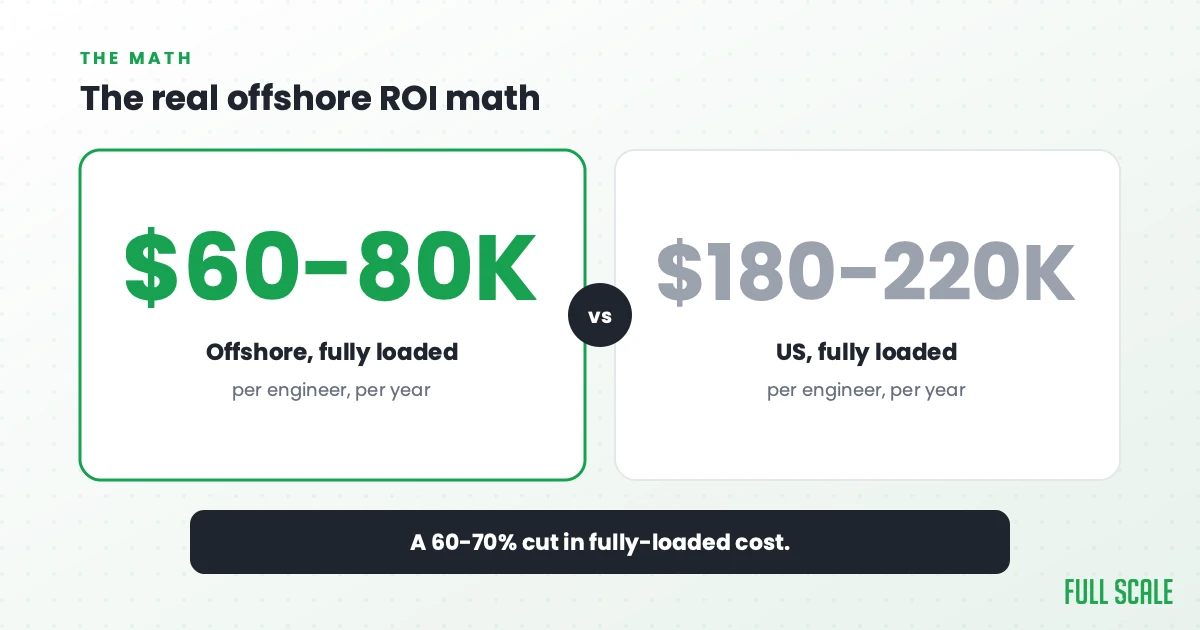
Real offshore ROI starts with a fully-loaded cost comparison. Not the hourly rate. The annual cost including salary, benefits, payroll taxes, recruiting, equipment, replacement, and the management overhead a team actually generates.
| Role | US Fully-Loaded Annual | Full Scale Offshore Annual | Approximate Savings |
|---|---|---|---|
| Senior full-stack engineer | $180,000 – $220,000 | $60,000 – $80,000 | 60-70% |
| Mid-level engineer | $130,000 – $160,000 | $40,000 – $60,000 | 55-70% |
| QA / automation engineer | $100,000 – $130,000 | $30,000 – $50,000 | 60-70% |
Those numbers are illustrative ranges, not a rate card. Full Scale’s published senior developer rate in the Philippines is $30 to $40 per hour. The fully-loaded annual figure rolls in benefits and infrastructure on top of that rate. The US side isn’t padded either: senior engineer base pay runs roughly $150,000 to $185,000 per BLS data, and the standard fully-loaded multiplier of 1.25 to 1.4x for benefits, taxes, equipment, and overhead is what pushes a senior US hire past $200,000 all in. For the full per-country rate breakdown by seniority, see our offshore developer rates by country guide.
The headline figure most posts lead with is 50 to 70 percent reduction in fully-loaded development cost. The range is real, but the variable that decides whether you land at 50 or 80 is whether you build a team or buy hours, not the country you pick.
How to Calculate Offshore ROI
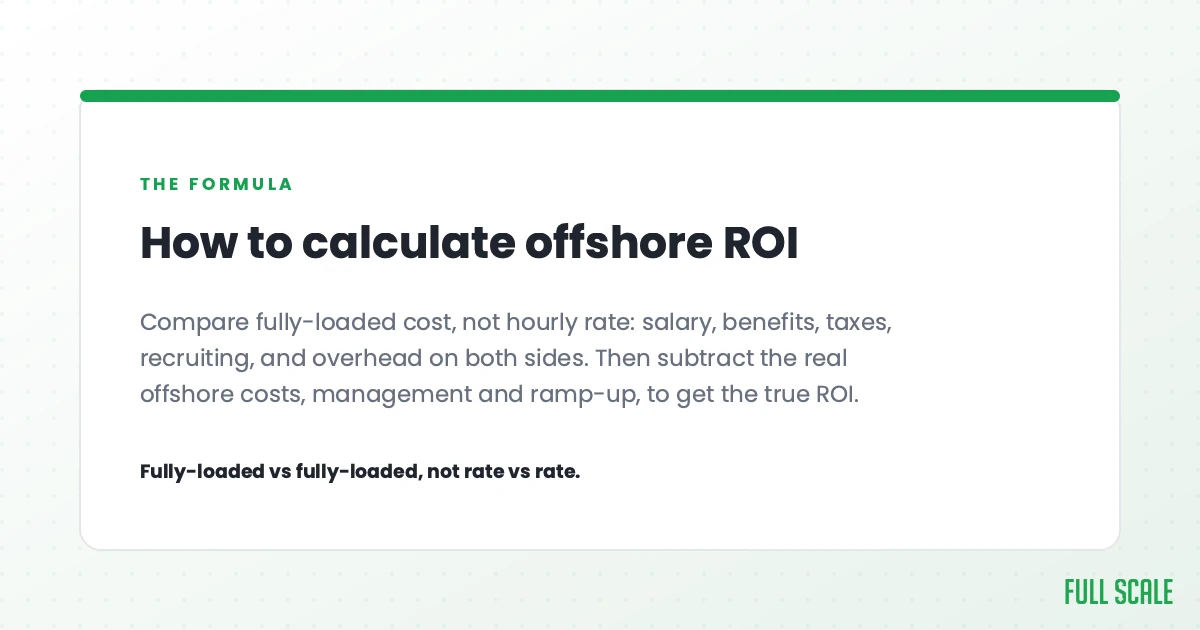
The fully-loaded comparison above is the starting point, not the answer. Real offshore ROI accounts for the productivity curve of a new team, not just the rate gap on day one.
For readers who want the underlying math, the formula is straightforward:
- Year 1 Savings = (US Cost − Offshore Cost) × Team Size × 0.7 productivity factor
- Year 2+ Savings = (US Cost − Offshore Cost) × Team Size × 0.9 productivity factor
The productivity multiplier is the variable most offshore ROI estimates ignore. It accounts for ramp time, communication overhead, and the natural learning curve of any new team. A new offshore engineer doesn’t deliver full output on day one, and a brand-new engagement carries more coordination cost than a team that has worked together for two years.
That multiplier also scales with how many hours of overlap your offshore team shares with your local team. Time zone overlap is a real cost driver. By year two, a well-integrated offshore team performs at about 90 percent of an equivalent local team, and that’s the threshold that makes the offshore ROI math hold up.
The Hidden Costs That Skew Offshore ROI
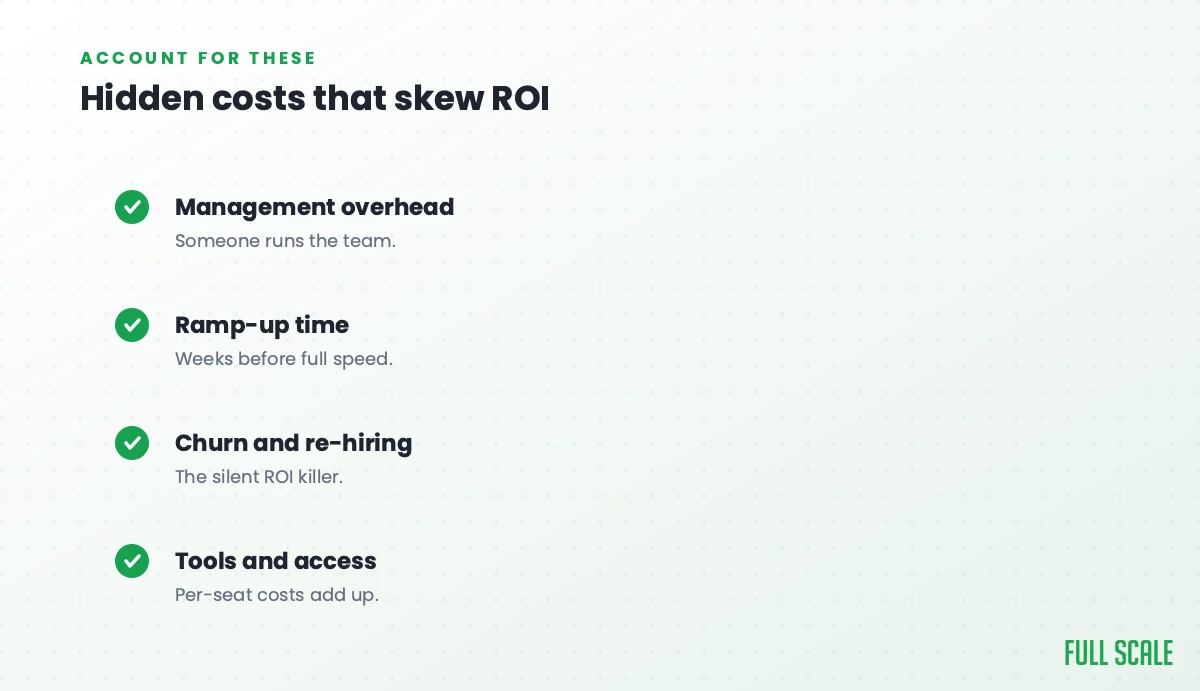
Rate savings get talked about. The hidden costs that erase them don’t. A good offshore development cost analysis accounts for four categories that almost always go unmodeled, and any one of them can wipe out the headline savings.
Ramp time. A new offshore developer takes 60-90 days to reach steady-state productivity. The first month is closer to 50-60 percent of full output, the second 70-80 percent, the third 85-95 percent. If you model offshore savings at 100 percent of expected output from day one, you’ll overstate year-one ROI by 20 to 30 percent.
Communication overhead. Poorly structured offshore engagements add 15 to 25 percent total project time to translation, rework, and back-and-forth on misaligned specs. Well-structured engagements add 5 to 10 percent. The variable is whether your team can talk directly to the developers or has to route everything through a project manager.
Rework from spec misalignment. Features built and rebuilt because the requirements didn’t reach the developer cleanly. This is the largest hidden cost in offshore work and the hardest to model in advance. The cheapest hour is the one nobody had to bill twice.
Replacement cost. Project-based offshore engagements end. When they do, the institutional knowledge walks out the door, and the next project starts from scratch. Team-based engagements with high retention (Full Scale’s developer retention is over 93 percent) preserve the knowledge across years, which keeps the savings durable.
For the full breakdown of how local-versus-offshore hiring economics actually compare, see our writeup on whether to outsource developers or hire in-house. And for the underlying cost drivers that affect any software project, our software development cost breakdown covers the rest.
Risk mitigation that preserves the ROI
The risks that erode offshore ROI cluster into four categories. Each has a known mitigation, and engagement partners that have done this before will have it built into how they operate.
| Risk Category | Mitigation Approach | Full Scale Advantage |
|---|---|---|
| Communication | Structured reporting, daily collaboration tools, direct dev-to-client access | Established protocols, native-fluent English, no project-manager middleman |
| Quality Control | Automated testing, code reviews, clear technical standards | Built-in quality processes, technical leadership inside the team |
| Intellectual Property | Legal protections, access controls, NDAs | Comprehensive security framework, compliance verification |
| Knowledge Transfer | Documentation requirements, overlapping responsibilities | Knowledge management tooling, technical documentation as a habit |
When all four risks are mitigated, the productivity multiplier in the ROI math holds at 0.7 in year one and 0.9 in year two and beyond. When they aren’t, the math degrades, and so does the savings.
ROI Examples From Named Clients
Two named clients anchor the math.
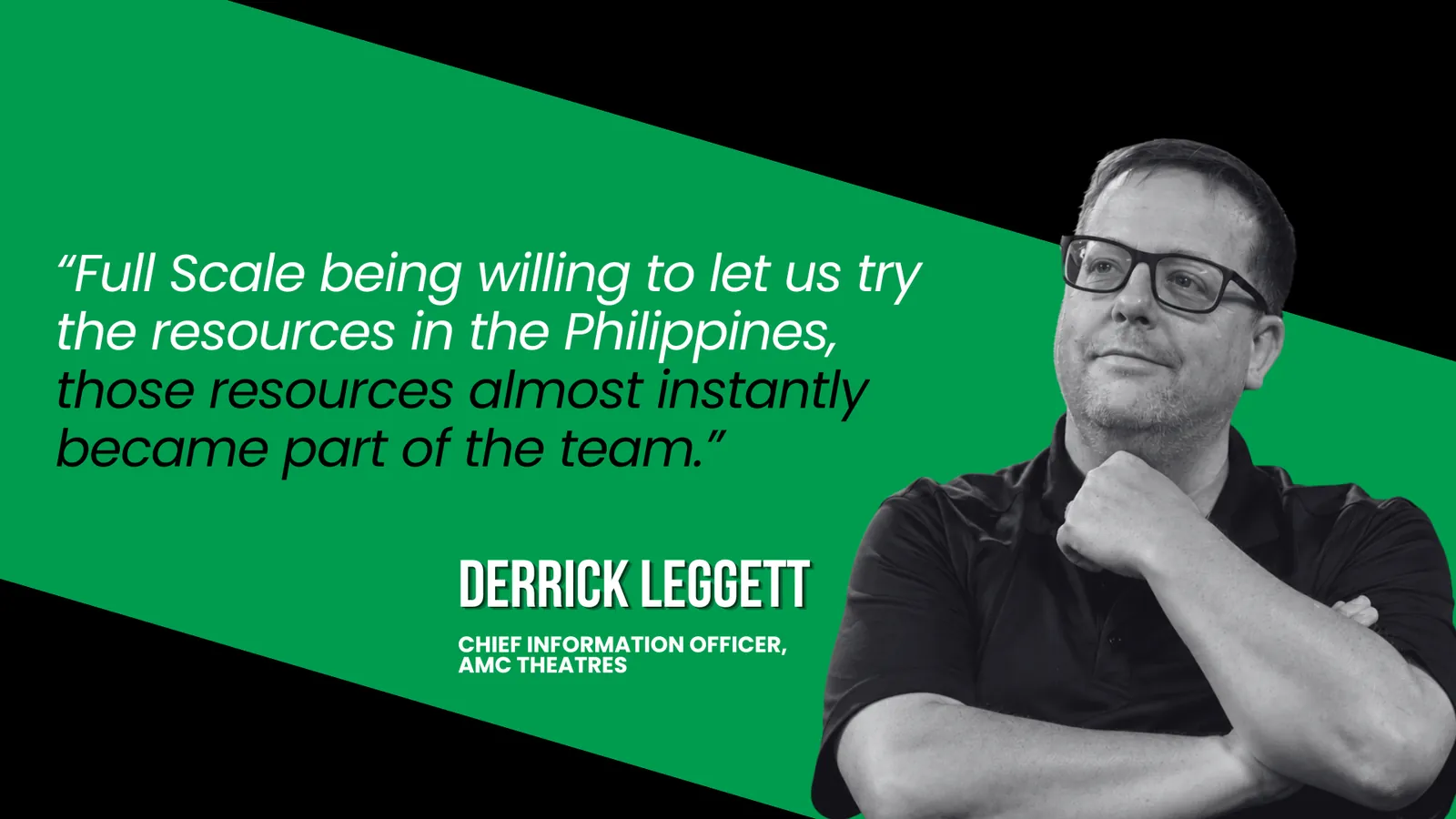
AMC Theatres runs a global engineering organization out of Kansas City under CIO Derrick Leggett. The developers Full Scale placed in the Philippines are treated as full AMC engineers, not as contractors. They sit in AMC’s standups, own features end to end, and have a seat at the table when architecture decisions get made. The fully-loaded cost reduction on backend and QA roles runs in the 60-70 percent range against equivalent US hires. The deeper saving is structural. In my experience, an integrated team like AMC’s delivers more product per dollar than the walled-off vendor model it replaced.
LendingStandard is one of our longest-running clients. They process roughly 30 percent of affordable multifamily property loans nationwide. They came to us after local hiring stalled. Here’s what their CEO Andy Kallenbach says about the team:
Waking up each morning to collaborate with the Full Scale team has become the highlight of my day. Their work ethic, pride in craftsmanship, and the sheer quality of their output have not only met but exceeded our expectations. The most significant impact has been the seamless integration of their team with ours, making every challenge surmountable and every success sweeter.
Andy is a CEO describing a team he works with every day, not a vendor writing marketing copy. Read the full LendingStandard case study.
Across the 200+ tech companies Full Scale has served, the pattern is the same. Long-term team beats project-based engagement. Direct developer access beats project-manager intermediation. Retention preserves savings. The math is straightforward; the structure is where most teams get it wrong.
Implementation Roadmap
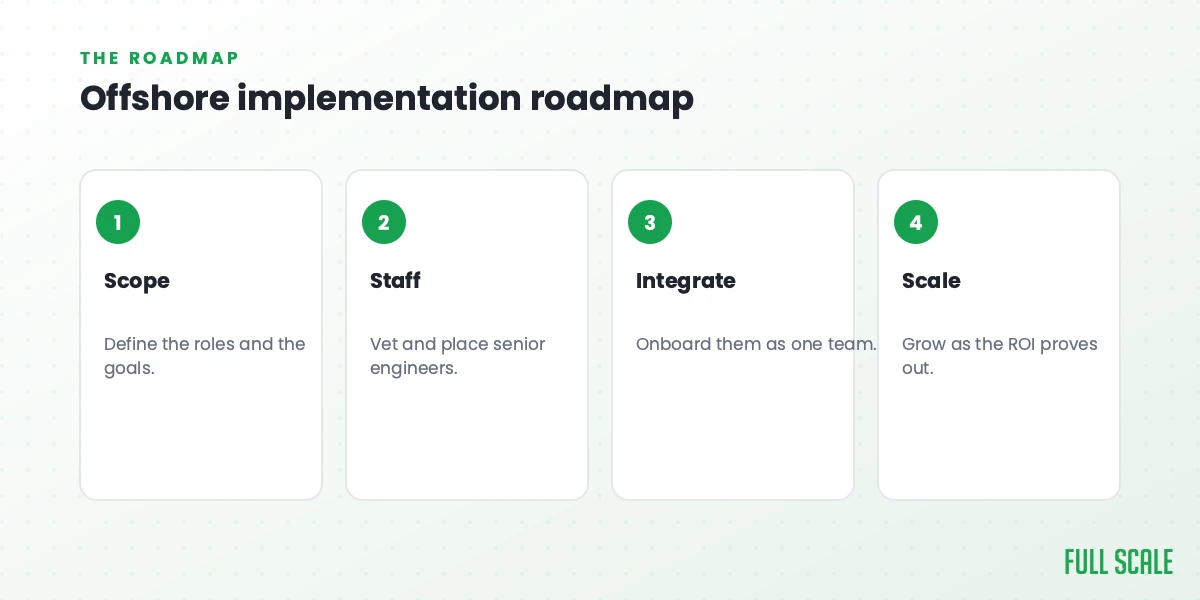
The math works when the implementation works. Two roadmaps depending on how aggressive your timeline is.
90-day quickstart
For teams ready to move fast and validate the model in a quarter:
- Weeks 1-2. Assessment and planning. Define requirements, identify pilot projects, set success metrics, prepare your communication infrastructure.
- Weeks 3-4. Partner selection and contracts. Conduct technical interviews. Lock contracts and rates.
- Weeks 5-8. Pilot team launch. Hire 2-3 developers, run daily standups, set up code reviews, monitor productivity.
- Weeks 9-12. Process optimization. Measure actual versus projected ROI, refine handoffs, document what worked.
Six-month comprehensive plan
For larger engagements where the cost of getting it wrong is bigger than the cost of going slower:
| Phase | Timeline | Objectives | Expected Outcomes |
|---|---|---|---|
| Assessment | Weeks 1-2 | Evaluate current costs, identify offshore candidates | Clear strategy, baseline ROI projections |
| Pilot Selection | Weeks 3-4 | Choose initial projects, define success metrics | Balanced pilot portfolio, measurement framework |
| Team Assembly | Weeks 5-8 | Recruit and onboard the initial offshore team | 3-5 developer team deployed |
| Pilot Execution | Months 3-5 | Complete initial projects, measure outcomes | Validated approach, refined processes |
| Scale Planning | Month 6 | Develop the expansion roadmap based on results | Detailed 12-month scale plan |
Both roadmaps share the same prerequisite. Decide first whether distributed development is the right model for your team. If it isn’t, the rate savings don’t matter. For the decision framework that sits upstream of the math, see our guide to building a dedicated development team.
Pricing Models for Offshore Engagements
Most engagements use one of four pricing models. Each fits a different shape of work.
- Dedicated team (retainer). Best for long-term product development with evolving scope. Monthly fixed cost per developer. Maximum flexibility.
- Fixed price. Best for scoped one-time deliverables with clear scope (a marketing site, a one-off integration). Vendors price in 20 to 30 percent contingency to cover scope changes you can’t predict.
- Time and materials. Best for agile work where the scope shifts quarter to quarter. Bill against actual hours.
- Hybrid. Mix of fixed-price for known deliverables and retainer for ongoing work. Best for larger programs with multiple workstreams.
For the depth on staff augmentation pricing specifically, including the difference between a dedicated team and a project-based engagement, see our staff augmentation pricing model guide.
When Offshore ROI Math Goes Wrong
Most offshore engagements that fail don’t fail on the rate. They fail on the structure. Four patterns surface most often.
Picking the cheapest country instead of the country your team can communicate with. I call this cheapshoring. The hourly rate looks great until you realize half the team can’t push back when the spec is wrong. The fix is to filter on communication first, then cost. For the model-comparison angle (nearshore versus offshore tradeoffs), see our nearshore versus offshore writeup.
Project-based outsourcing for long-term product work. Project pricing optimizes the vendor’s incentive to ship the spec as written, not to ship the right product. You save on the rate and pay it back in rework. Staff augmentation as a long-term team is the structural alternative. I have watched that exact trade play out in offshore web development, where the team model is what keeps the savings real.
Letting a “technical project manager” sit between you and the developers. This is the most common failure mode in offshore work. The developers hide behind the PM, you never build a relationship with the people writing the code, and every decision flows through a middleman. The fix is making the developers part of your team, on your Slack, in your standups, accountable to your product manager.
Treating offshore as a vendor instead of as a team. Vendor relationships end. Team relationships compound. The single biggest predictor of offshore ROI durability is whether the developers stay long enough to accumulate institutional knowledge.
For the cost-reduction angle that fixes these structural problems instead of squeezing the rate, see our writeup on how to reduce software development costs without losing your team.
Frequently Asked Questions About Offshore Development ROI
How do you calculate offshore development ROI?
Offshore development ROI equals US fully-loaded cost minus offshore fully-loaded cost, times team size, times the productivity factor, divided by the offshore cost. Apply a 0.7 productivity factor in year one to account for ramp time, then 0.9 in year two and beyond once the team is integrated. For a 5-developer team, year-one savings typically run 40 to 50 percent of the equivalent US cost. Year-two savings climb to 55 to 70 percent as the team reaches full velocity.
What is the average ROI for offshore development?
Most companies see 50 to 70 percent reduction in fully-loaded development cost when hiring offshore through a long-term team partner That savings range assumes the team question is already settled; if it is not, the deeper offshore vs. onshore dedicated team decision comes first.. The range depends on engagement structure. Project-based offshore typically returns lower ROI because rate savings get eaten by rework and management overhead. Long-term team-based engagements hold the savings durably.
How long before you see ROI from an offshore team?
Most teams break even within 3 to 4 months of the engagement starting. Year-one positive ROI is typical for companies with engineering leadership in-house to manage the team. Companies trying to outsource the engineering leadership itself rarely see positive ROI in year one because they’re missing the layer that makes offshore work in the first place.
What hidden costs affect offshore ROI?
Four categories. Ramp time (productivity is 60-70 percent in the first 60 days). Communication overhead (10-25 percent of total project time when structure is weak). Rework from spec misalignment (can double the development time). Replacement cost when project-based engagements end and institutional knowledge walks out the door. Our writeup on whether to outsource developers or hire in-house covers the in-house comparison in depth.
Is offshore cheaper than onshore in the long run?
For ongoing product development, yes, when structured as a long-term team. The fully-loaded cost per senior engineer runs 50 to 70 percent lower offshore, and that gap holds across years as long as retention stays high. Full Scale’s developer retention is over 93 percent, which keeps the savings durable. Project-based offshore engagements with constant team turnover don’t hold the cost advantage. That’s also the case for being selective, not just cheap: the math falls apart if you don’t end up with offshore developers who actually stay.
How is offshore ROI different from outsourcing ROI?
They’re often used interchangeably, but the engagement model matters. Outsourcing typically means buying a deliverable at a fixed price. Offshore staff augmentation means hiring engineers who work directly for your team. The ROI math is different. Outsourcing rolls cost into per-project pricing. Staff augmentation looks more like a payroll line item. We’ve written about this in our staff augmentation pricing model guide.
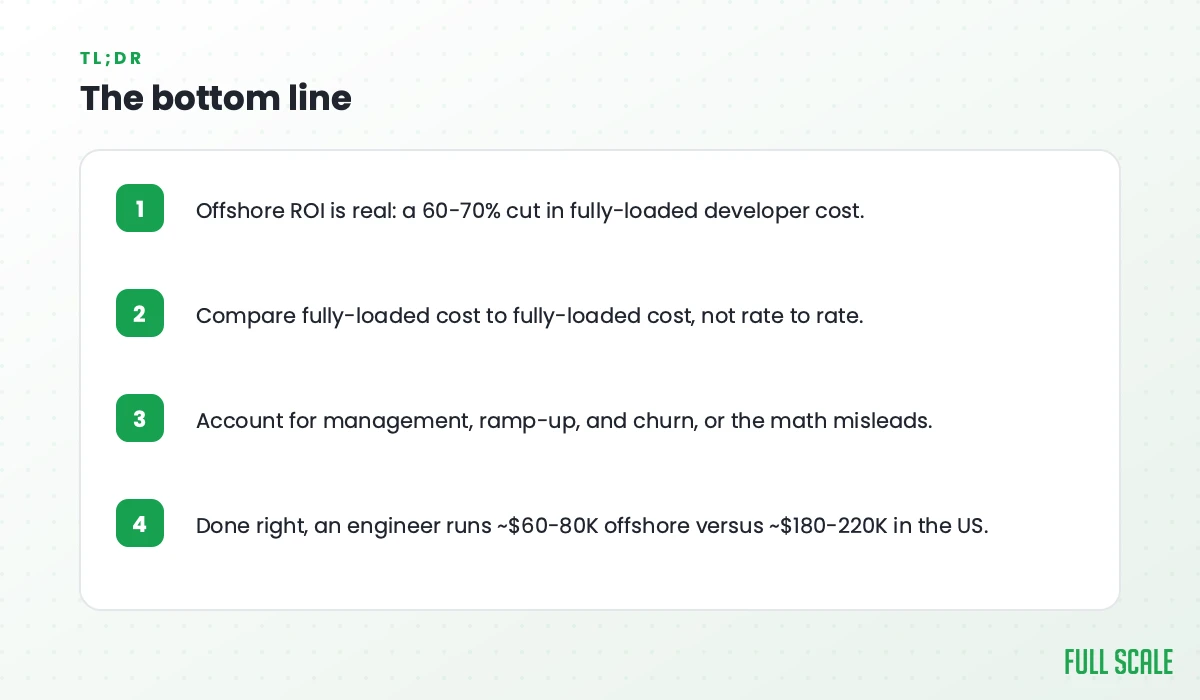
The Bottom Line
Offshore ROI lives or dies on whether you’re building a team or buying hours. The math follows.
Want the math on your specific situation? Schedule a call and we’ll run the numbers together.