
Offshore Python Development: The Talent Pool Is Deep. The Quality Range Is Deeper.

In this article
- What Offshore Python Development Covers in 2026
- The Quality Gap Is Real
- The Philippines for Python Offshore Work
- How to Evaluate an Offshore Python Developer
- Staff Augmentation or Project Outsourcing?
- What the Cost Comparison Looks Like
- What AI Changes About Offshore Python Work
- Frequently Asked Questions
- Ready to Add Python Engineers to Your Team?
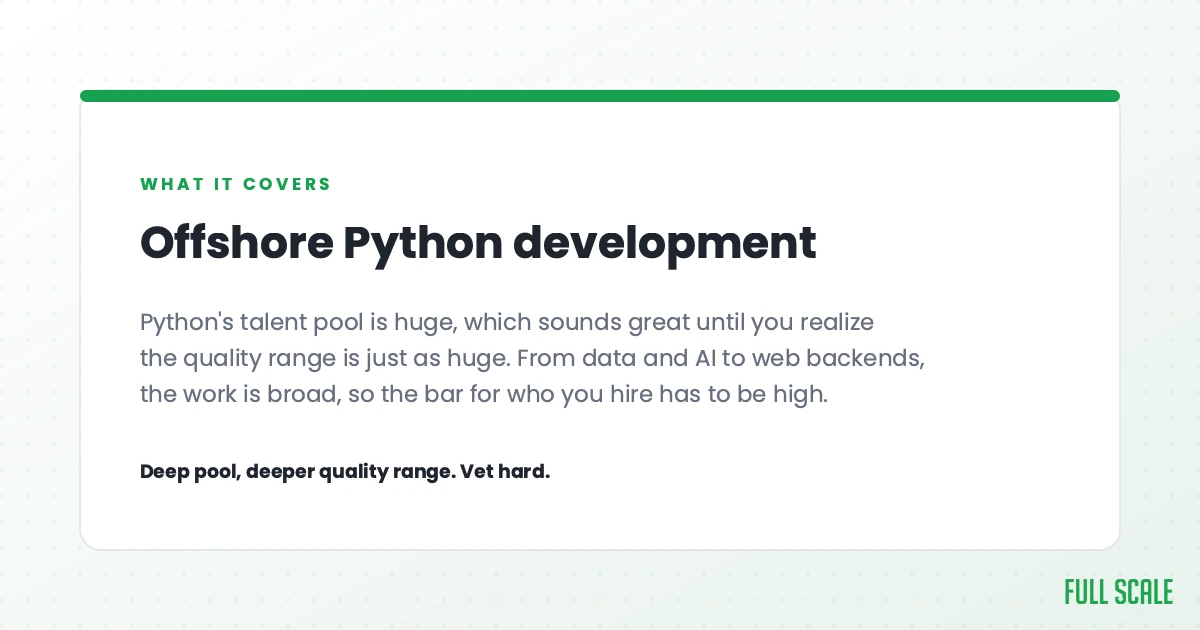
Python is the most popular programming language in the world. That distinction shows up everywhere: at the top of every major language survey, in every data science job posting, in every AI/ML pipeline running in production right now. It also means that when you go looking for offshore Python developers, you are searching inside the largest developer talent pool on the planet. Django is where much of that Python talent concentrates, which is why teams building on it hire dedicated Django developers from the same pool. It also shapes how we think about what a Python developer actually does now.
That sounds like an advantage. It is. It is also exactly why offshore Python development fails more often than CTOs expect.
A junior developer who can write a Django CRUD app and a senior engineer who can architect an asynchronous FastAPI service fronting an LLM inference layer are both “Python developers.” The first costs half the second. The first also ships something you’ll spend years untangling if the job called for the second. The size of the talent pool means you have more options at every price point, including a lot of options that look qualified until the production system starts misbehaving in ways a good architect would have seen coming.
I have built Python myself. At Stackify, my APM and developer-tools company, Python was part of the monitoring agent pipeline, the piece that collects performance data from production apps. I have also hired Python developers across multiple countries, and I run Full Scale, which staffs Python teams for clients in 2026. I know both ends of this. The talent pool is real. The quality range is real. The path through it is the part most posts on this topic skip.
What Offshore Python Development Covers in 2026
“Offshore Python development” meant something narrower five years ago. It meant Django web apps, Flask APIs, data scripts. The stack was more homogeneous.
In 2026 the Python landscape that offshore engineers actually work on is substantially wider:
- Web backends: Django, FastAPI, Flask. The three dominant frameworks, each with its own mental model and scaling characteristics.
- Data engineering: pandas, dbt, Airflow, Spark (PySpark). Data pipelines that feed analytics and AI/ML systems.
- AI/ML work: model training, inference services, LLM orchestration with LangChain or similar. Python is the language of the AI era, not by coincidence.
- Scripting, automation, DevOps glue code. The Python that holds everything else together.
This matters for hiring because “offshore Python developer” is not one job description. A candidate who is excellent at FastAPI service design may have never touched Airflow. A data engineer who can build a production pipeline may not know Django’s ORM well enough to work on an existing web backend. When you evaluate offshore Python engineers, you are not just evaluating Python. You are evaluating which part of the Python world they have actually built in.
The Quality Gap Is Real
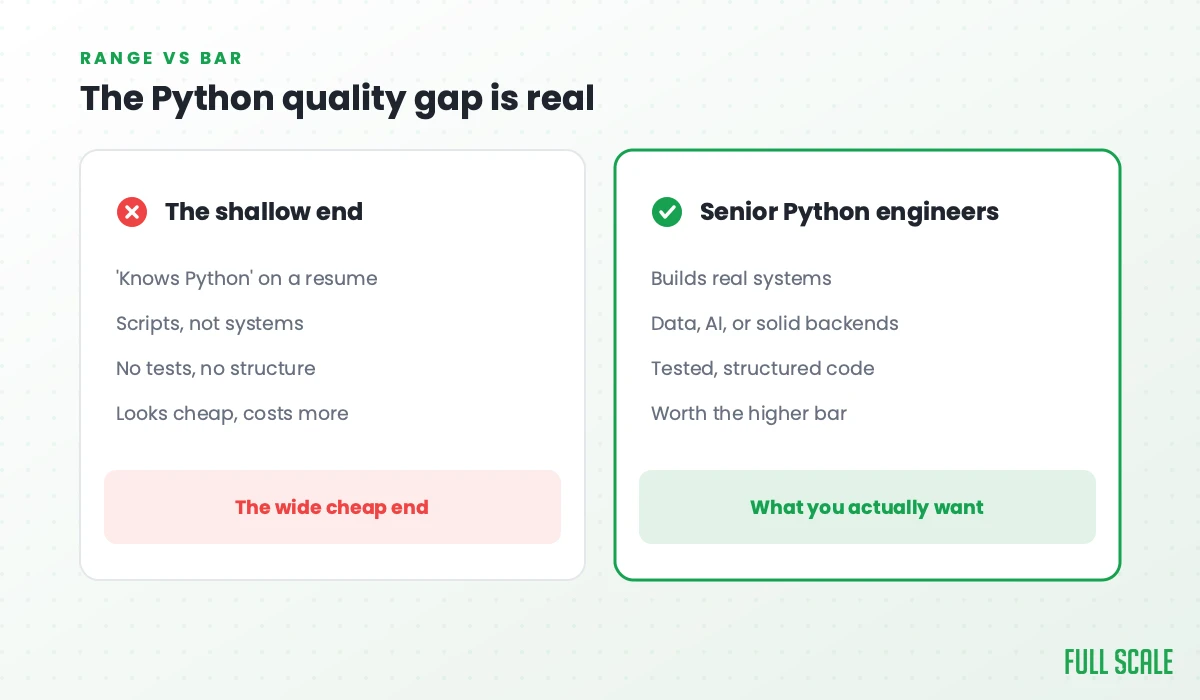
Here is what I have seen staffing Python teams: the talent pool’s size creates a quality gradient that is steeper than in most other languages. Python is easy to start with. The language is forgiving. You can write Python that runs without ever understanding concurrency, memory management, or what happens to your async event loop when you call a blocking library inside it. The same operator lens applies to offshore Rails development: a smaller pool than Python means the quality cliff is steeper, but Rails’s conventions make strong engineers more identifiable and their code more consistent. The same evaluation lens applies to offshore Angular work: Angular’s DI and RxJS patterns make the quality gap visible in code review, and finding engineers who understand the framework deeply is more important than finding engineers who know the syntax. PHP behaves the same way, which is why my comparison of the major PHP MVC options leans so heavily on who you can actually hire for each one.
That forgiving quality is part of why Python grew so fast. It is also why cheapshoring (hiring the cheapest offshore developer available and hoping the output matches what you need) is most dangerous with Python. The world is full of developers who can write Python. Far fewer of them can review AI-generated Python, catch the architectural mistakes it makes, and push back when a spec is asking for the wrong thing.
At Stackify, the Python engineers who worked on our agent pipeline needed to understand performance at a level that most web developers never have to think about. An agent that collects metrics from a production app cannot itself become a production problem. The bar was specific and high, and it was not visible on a resume.
The practical takeaway: when you are evaluating offshore Python developers, treat the resume as the starting point, not the answer. Python experience is cheap to claim. Ask candidates to walk through a system they have built that had a real performance or concurrency constraint. Ask them what broke and how they fixed it. The engineers who can answer that question in detail are the ones you want.
What breaks most Python offshore engagements is hiring into the large, cheap, accessible part of the talent pool and expecting the output you only get from the smaller, more expensive, harder-to-find part. Language knowledge is rarely the thing that fails. I call this cheapshoring. Python makes it easier than almost anything else to fall into that trap because supply pressure at the cheap end of the market is constant.
The Philippines for Python Offshore Work
There are Python developers everywhere. I have hired them in Russia, Colombia, Uruguay, and the Philippines. The reason Full Scale operates out of the Philippines is not the hourly rate. It is the combination of things that makes a distributed Python team actually function day to day.
The Philippines is the third-largest English-speaking country in the world, so the language barrier in either direction is effectively zero. Filipino engineers grew up with American culture as their ambient media environment, and the communication style is direct enough to be useful in a code review and warm enough that the relationship feels like a collaboration. For an embedded Python engineer, one who is in your standups, reviewing pull requests, and raising a concern about your data model before it ships, that day-to-day communication is what determines whether the team works, far more than the hourly rate does.
The Philippine IT-BPM industry generates $40 billion in annual export revenue and employs 1.8 million workers. The Python talent pool is deep and the infrastructure for remote engineering teams is mature.
How to Evaluate an Offshore Python Developer
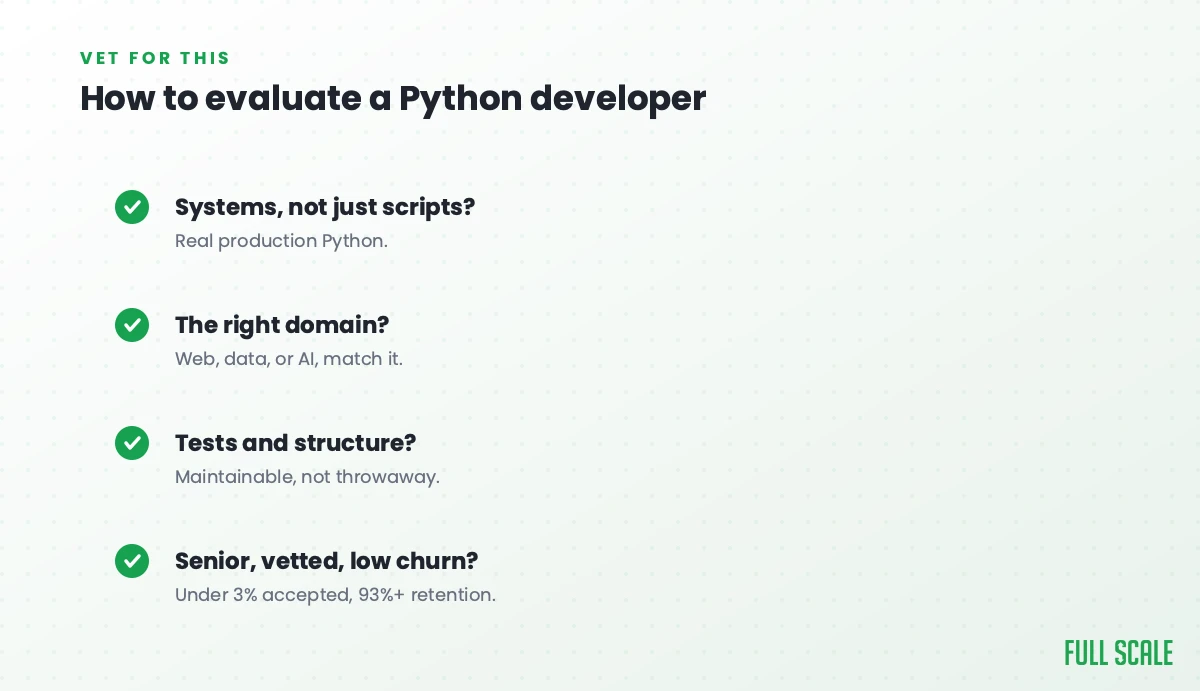
You cannot tell a great Python engineer from a mediocre one by looking at the Python line on their resume. Here is what actually gives you signal:
What they have built that had real constraints. Ask about a system where performance, concurrency, or scale forced specific decisions. A developer who has only written Django CRUD apps against small databases will talk in frameworks and features. A developer who has built something that had to perform under load will talk about what broke and why.
How they communicate about uncertainty. Give them a requirement with a gap in it. Watch whether they ask the clarifying question or just build to the literal spec. The best Python engineers I have seen, offshore and onshore, treat ambiguity as something to surface, not ignore.
Framework depth beyond syntax. If they say they know FastAPI, ask about dependency injection, request lifecycle, and background tasks. If they say they know Django, ask about the ORM’s N+1 problem and how they have addressed it in production. Syntax knowledge is table stakes. System-level understanding is the real test.
Code they own, not code they were told to write. The difference between a software engineer and a software developer shows up in whether someone takes ownership of what they build. Ask what they would have done differently in a project they worked on. Engineers who have an opinion about their own past work are the ones who will care about your codebase.
Staff Augmentation or Project Outsourcing?
If you want offshore Python engineers embedded in your team, working in your standups, reviewing your code, joining your architecture discussions, then staff augmentation, not a project handoff, is the model that works. The engineers become institutional knowledge holders. They know your codebase in six months in a way a project vendor never will.
If you have a genuinely scoped Python project, like a one-time data migration with a locked schema or a short-term integration with a defined API, project outsourcing can work. I have done it myself for exactly those kinds of scoped projects. The key word is scoped. If your Python work will keep evolving, you need engineers on your team, not a deliverable from a vendor.
If you are evaluating whether to outsource a Python project or build a long-term team, our outsource Python development guide covers the decision fork end to end.
What the Cost Comparison Looks Like
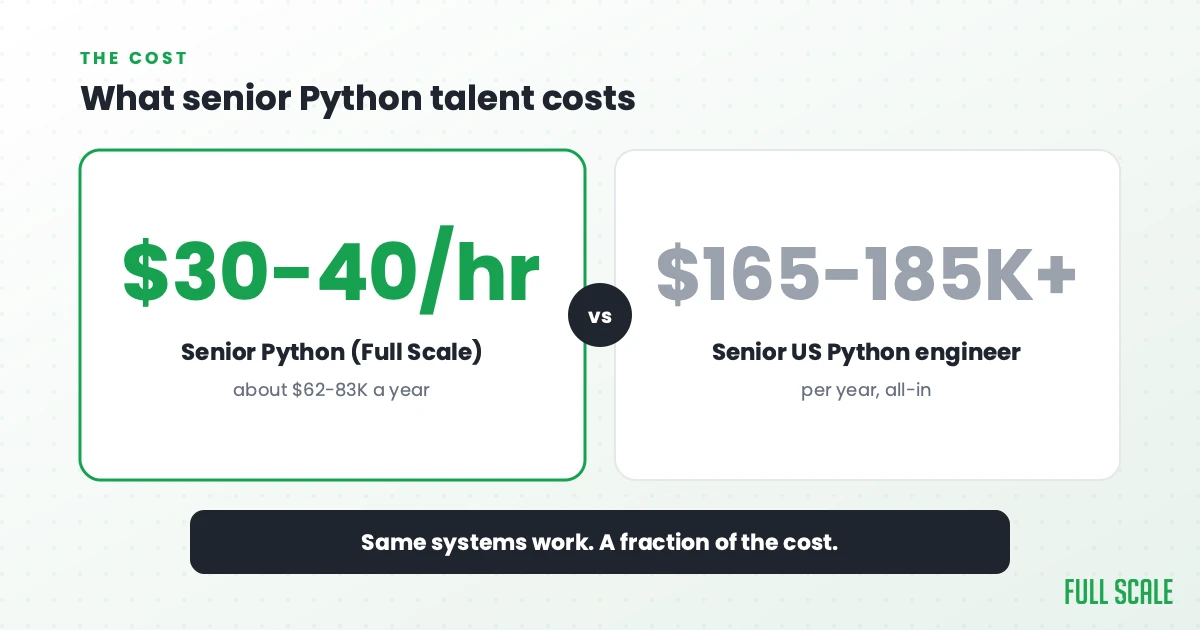
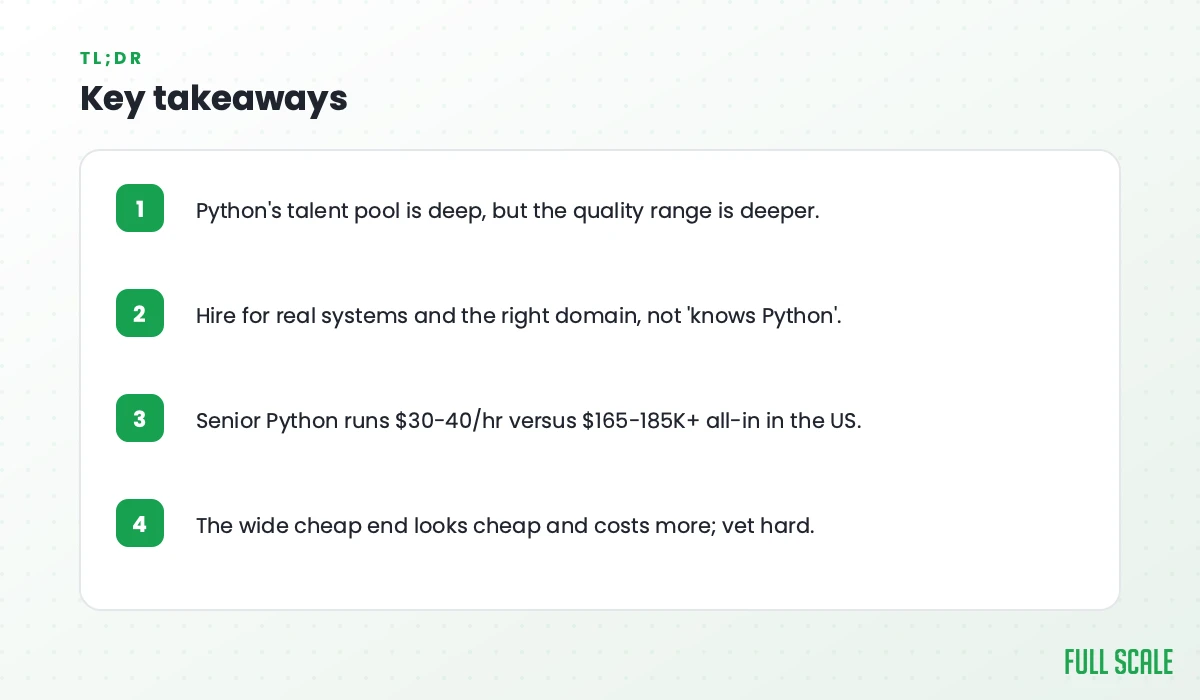
Full Scale clients typically pay $30–$40 per hour for a senior Python engineer in the Philippines. A comparable engineer in the US earns a BLS median of around $133,000 per year in base salary, and when you add benefits, payroll taxes, and overhead, what MIT research estimates at 1.25 to 1.4 times base salary, the all-in cost of a senior US Python engineer runs $165,000 to $185,000 or more per year.
| Full Scale (Python, Philippines) | US Senior Python Engineer | |
|---|---|---|
| Hourly / annual cost | $30–$40/hr (~$62K–$83K/yr) | $133K base → ~$165K–$185K all-in |
| Time to staff | ~14 days | 6–12 weeks |
| Recruiting fee | None | 20–25% of first-year salary |
The caveat is the same one I give on every offshore cost conversation: that gap only matters if the model is right and the engineer is right. A cheap Python developer who writes code you spend a year debugging is not a bargain. And the economics compound the other way too. A senior Python engineer you keep for three years, who knows your data pipeline and your edge cases, is worth far more than the same seat refilled every eighteen months at a US loaded cost.
What AI Changes About Offshore Python Work
Python is the language AI generates most fluently. It is also the language AI gets most confidently wrong in ways that are hard to spot. A model-generated FastAPI service might look clean and pass tests and still have concurrency bugs that only surface under real load. A data pipeline written by an AI might handle the happy path perfectly and corrupt a batch silently when a schema changes.
The engineers who catch this are not the ones who know the most Python. They are the ones who understand the system they are building well enough to read AI output critically. That is the same skill that separates great software engineers from great code producers, and it is exactly what Product Driven is about: building engineers who take ownership of what they are building and why, not just engineers who ship what they are told.
Offshore Python engineers in the Philippines are training for this. The Spartan Training Academy sessions are not tutorials on Python syntax. They are sessions on how to use AI effectively as a development partner: how to review AI-generated code, how to prompt for specific architectural patterns, how to catch what the model misses. By mid-2026, Full Scale has probably put its engineers through more AI training than they wanted. The reason: I refuse to get a year from now and have clients return developers because those engineers never caught up with AI and are now behind the times.
Frequently Asked Questions
What is offshore Python development?
Offshore Python development means engaging engineers based outside your country to work on Python projects: web backends, data pipelines, AI/ML systems, automation, and more. The model can be project outsourcing (a vendor delivers a scope of work) or staff augmentation (engineers join your team directly). For Python work that will evolve over time, staff augmentation delivers better outcomes because the engineers accumulate institutional knowledge.
Why does offshore Python development fail?
Most failures come down to the quality gap. The Python talent pool is enormous, which means the bottom of the pool is very accessible. Companies that hire into the cheap, accessible part of the pool, what I call cheapshoring, often get Python code that runs but cannot scale, architects poorly, or breaks in production under conditions the developer never tested for. The fix is better evaluation, not less offshoring.
How much does it cost to hire offshore Python developers?
At Full Scale, senior Python developers in the Philippines are staffed at $30–$40 per hour, with typical onboarding timelines of 14 days. A comparable senior engineer in the US costs $133,000 or more in base salary before benefits, payroll taxes, and recruiting overhead. The cost gap is real, but it only materializes as a win if the engineer is the right one. Model and talent selection come first.
Why hire offshore Python developers in the Philippines?
The Philippines leads on the combination that makes offshore Python work function: English fluency with American-culture context, a service and communication culture that translates directly into collaborative engineering, and a growing track record in Python AI/ML work. The old offshore model, hand a spec over the wall and get code back, is increasingly replaceable by AI. What survives is the engineer who communicates, challenges assumptions, and catches what AI gets wrong. That is where the Philippines leads.
Ready to Add Python Engineers to Your Team?
Full Scale has been staffing offshore software development teams since 2018. We have placed 700+ developers with clients across 200+ tech companies. Our Python engineers work inside engineering organizations across North America, building web backends, data pipelines, and AI-adjacent systems.
If you want to hire Python developers who work inside your team, join your standups, and take ownership of what they build, that is what we staff.
Schedule a call to talk through your Python team needs.