
The Complete Guide to Offshore PHP Development: How to Build High-Performance Teams Without the Usual Mistakes

In this article
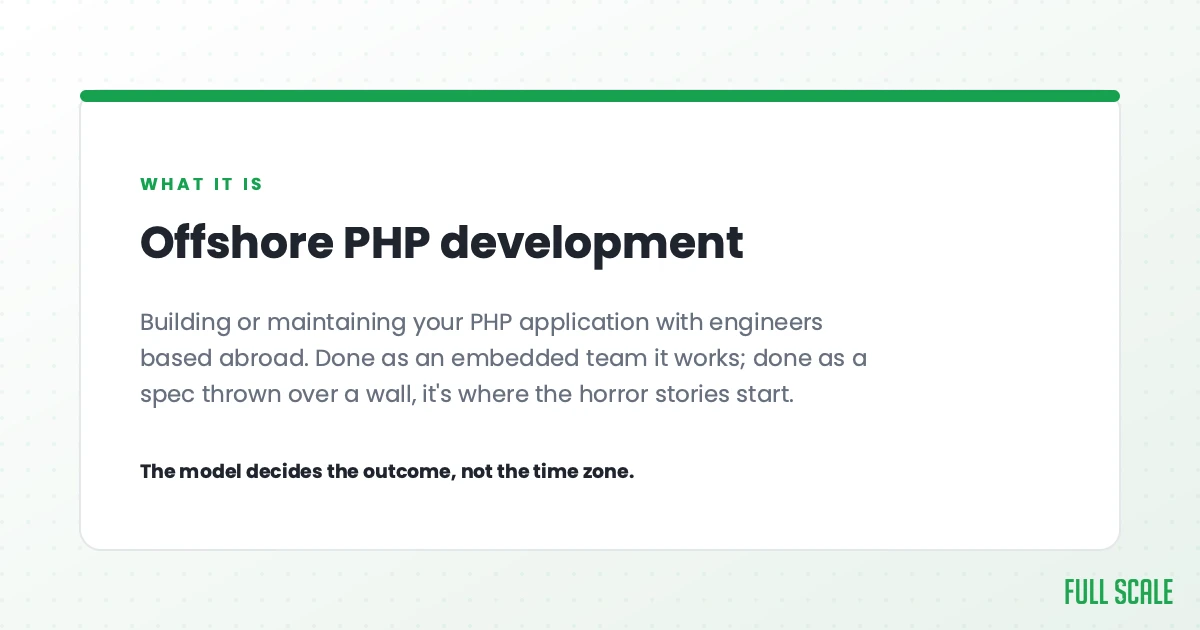
- What Is Offshore PHP Development? (And Why the Model Matters More Than the Location)
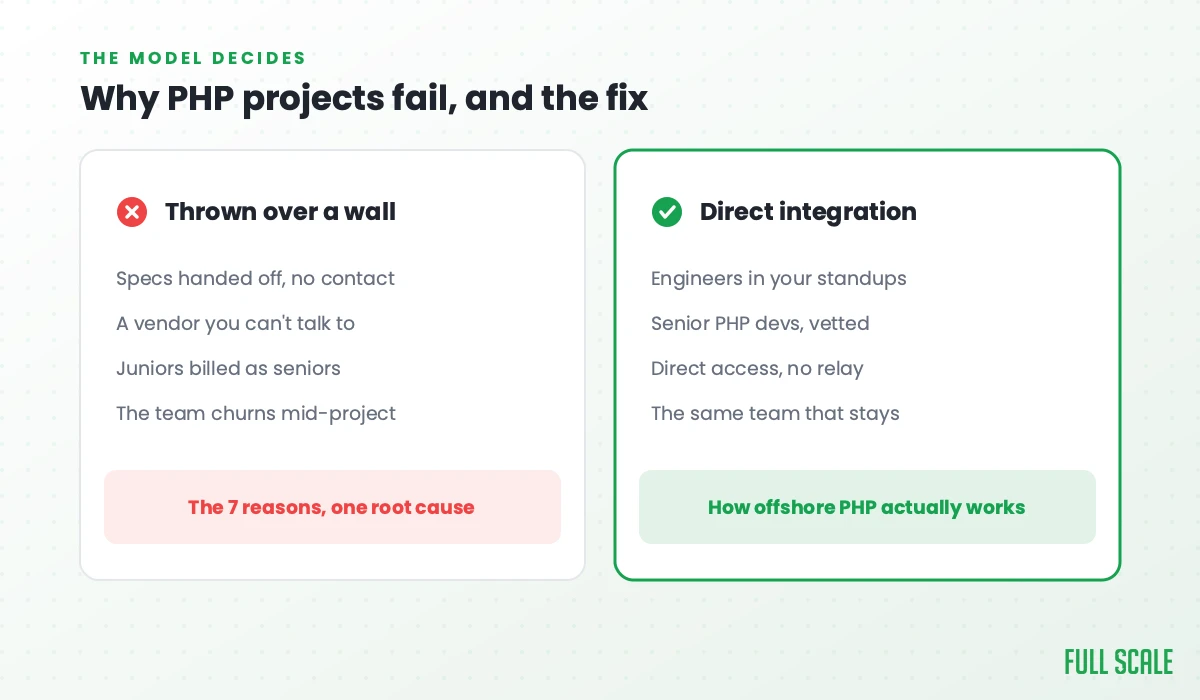
- The 7 Reasons Offshore PHP Projects Fail
- The Full Scale Direct Integration Model for PHP Development
- The 5-Stage Vetting Process: How We Find Senior PHP Developers
- The 7-Day Integration Framework: From Kickoff to Fully Productive
- The Real Cost of Offshore PHP Development
- The PHP Codebases That Offshore Best
- When to Use Offshore PHP Development (And When NOT To)
- Common Objections to Offshore PHP Development
- Why Full Scale for Offshore PHP Development
- Ready to Build Your Offshore PHP Team?
- Frequently asked questions
The Complete Guide to Offshore PHP Development: How to Build High-Performance Teams Without the Usual Mistakes
I’ve been building on PHP and Laravel for years, including on projects I own and run. So when companies ask me whether offshore PHP development actually works, I can answer from both sides of the table: as someone who’s built PHP products and as someone who’s placed 700+ developers at Full Scale since 2018. On the language decision itself, see PHP vs Node.js.
The short answer: it works when you choose the right model. Most companies don’t.
When offshore PHP projects fail, it’s almost never because of the developers. It’s not because of time zones or language barriers. It’s because the company used a project outsourcing model, where they handed requirements to a project manager, got developers they never talked to, and couldn’t figure out why the code didn’t match what they asked for. I’ve seen every version of how offshore development goes wrong, and model failure accounts for most of it. A lot of it starts upstream, with a brief that never says what a PHP developer actually does now.
The Direct Integration model fixes this. Your offshore PHP developers are in your Slack, on your standups, in your GitHub. Full Scale handles payroll, HR, and workspace. You handle everything else. The difference in outcomes is dramatic. The same model is what makes offshore backend engineers productive across any stack, not just PHP.
Here’s everything I’ve learned, from running my own companies on PHP to placing 700+ developers with more than 200 tech companies, about making offshore PHP development actually work.
What you’ll learn in this guide:
- Why most offshore PHP projects fail (and the one structural change that fixes it)
- The Direct Integration Model vs. traditional outsourcing, and why the difference matters more than any other variable
- Full Scale’s 5-stage vetting process that achieves 93% annual developer retention
- Real cost comparisons, including the numbers most offshore companies don’t show you
- Which PHP codebases offshore well, and which don’t
- When offshore PHP development is the right call, and when it isn’t
What Is Offshore PHP Development? (And Why the Model Matters More Than the Location)
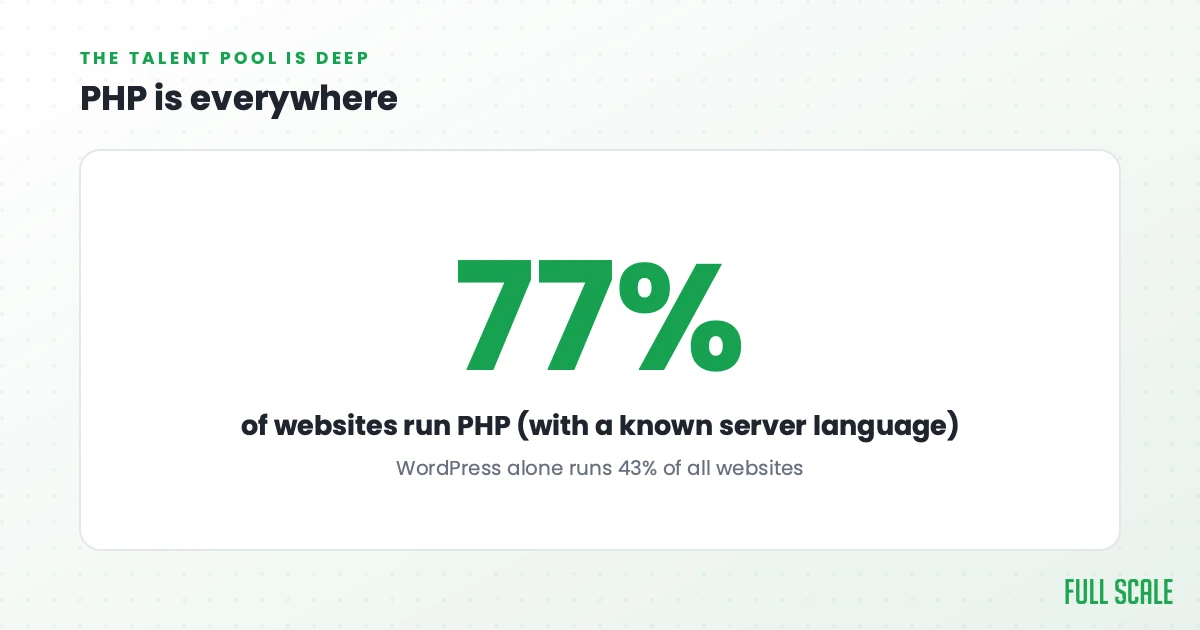
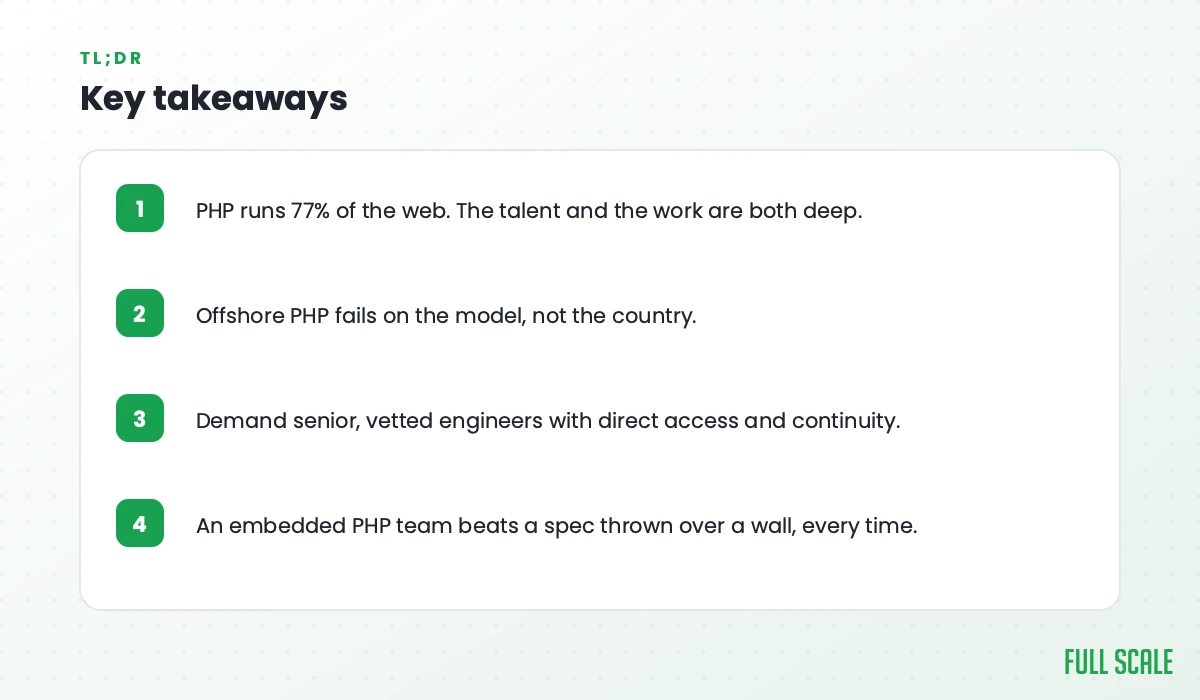
PHP powers over 77% of websites with a known server-side language. WordPress alone runs more than 43% of all websites. If your company is building SaaS on Laravel, running e-commerce on WooCommerce or Magento, or maintaining a legacy PHP codebase, you’re working with one of the largest developer communities in the world.
Offshore PHP development is the practice of hiring PHP developers located in another country to work on your software projects. But the definition that actually matters isn’t where the developers are. It’s how they work with your team.
There are two models. One works. One doesn’t.
Model 1: Traditional Project Outsourcing (Why It Fails)
Structure: You → Account Manager → Project Manager → Team Lead → Developers.
Four people between you and the person writing your code. Every layer adds miscommunication. Your requirements get through the telephone game, and by the time they reach a developer, the important context is gone.
The problems compound fast:
- No direct communication. Requirements get filtered through multiple layers
- No real control. You can’t adjust priorities or give feedback in real time
- High turnover. Developers treated as disposable contractors, not team members
- 40% annual turnover is common across traditional offshore agencies
This model might work for a one-off project with completely fixed specs that never change. Good luck finding that.
Model 2: Direct Integration / Staff Augmentation (What Actually Works)
Structure: You ←→ Developers (Full Scale handles payroll, HR, and workspace).
Your offshore PHP developers are in your Slack. They attend your standups. They pair program with your local team. They commit directly to your GitHub repos. They follow your coding standards. They participate in your retrospectives.
The outcomes:
- Direct communication. No telephone game, no miscommunication layers
- Full control. You manage work and priorities the same way you do for any team member
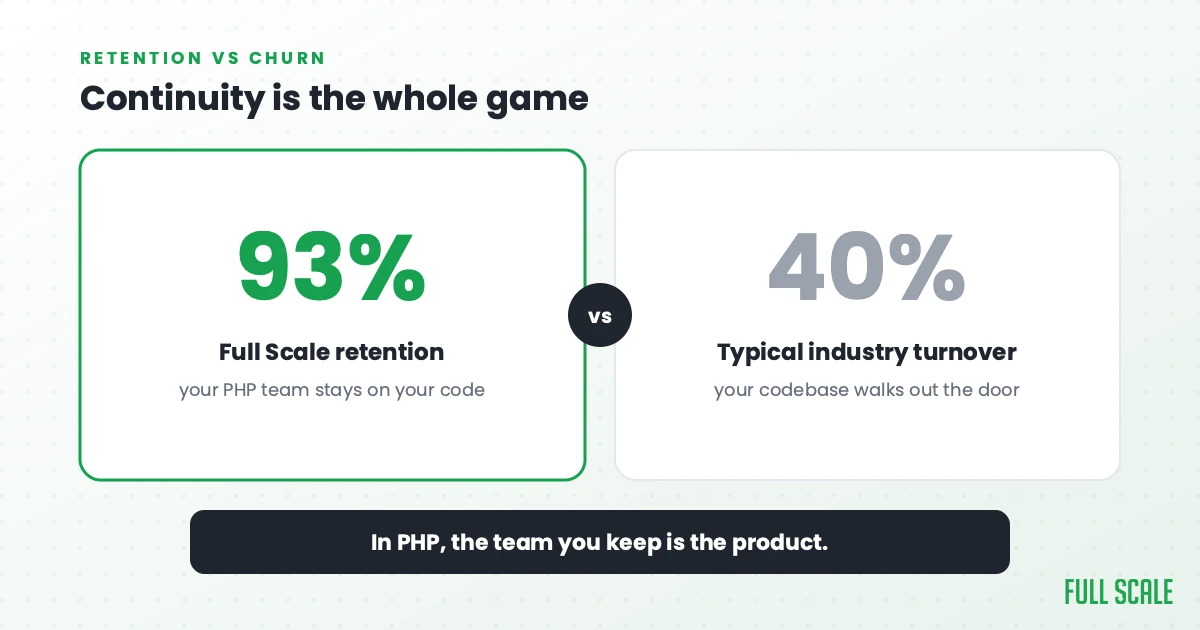
- 93% annual developer retention at Full Scale vs. 40% annual turnover at traditional agencies
- Onboarded and committing code in 7-14 days, not 4-12 weeks
| Factor | Traditional Outsourcing | Direct Integration (Full Scale) |
|---|---|---|
| Communication | You → PM → Developers | You ←→ Developers (direct) |
| Control | Low (black box) | High (full transparency) |
| Annual turnover | ~40% | ~7% (93% retention) |
| Start time | 4-12 weeks | 7-14 days |
| Developer relationship | Disposable contractor | Team member |
| Integration | Separate workflow | Your tools, your processes |
When CTOs tell me offshore PHP development failed them, I ask which model they used. Almost every time, it was project outsourcing. That’s not an offshore failure. That’s a model failure.
The 7 Reasons Offshore PHP Projects Fail
If you’ve been burned by offshore PHP development before, you’ve probably hit one of these. The good news: all seven are avoidable.
Reason 1: Choosing Price Over Quality
The mistake. You see ads for $15/hour PHP developers. It sounds amazing. You hire them expecting senior-level work.
You get code held together with duct tape. No tests. No documentation. Spaghetti logic everywhere.
The fix. Market rates for senior offshore PHP developers at Full Scale: $30-$40/hour to the client, which translates to roughly $62K-$83K annually. Still 50-60% below US total compensation for the same role. But you’re getting actual senior talent. These are developers who passed a rigorous vetting process that rejects more than 97% of applicants.
The correlation between rate and quality is real. In my experience reviewing developer work across hundreds of PHP engagements, the $15/hour tier produces code that almost always needs significant rework. The $30-$40/hour tier rarely does. You’re not paying for the location. You’re paying for the quality of the vetting process that backs the rate.
You get what you pay for. The question is whether you want to pay for quality code now or refactoring costs later.
Reason 2: Using Project Outsourcing Instead of Staff Augmentation
The mistake. You hire an agency. They assign a project manager. That PM manages developers you never talk to. Requirements get lost. Context disappears. Features get built wrong.
The fix. Direct integration means your offshore PHP team attends your standups. Uses your Slack. Follows your processes. No middlemen translating requirements.
A SaaS company we worked with switched from project outsourcing to staff augmentation. Their velocity doubled in eight weeks. Developers finally understood the why behind features, not just the what.
Reason 3: Inadequate Vetting Process
The mistake. You trust the vendor’s resume screening. You skip technical assessments. You hire based on “five years of PHP experience.”
Then you discover those five years were spent copying Stack Overflow answers.
The fix. Full Scale’s 5-stage vetting process (detailed later). Live coding exercises. Architecture discussions. Portfolio code review. Cultural fit assessment.
Fewer than 3% of applicants make it through. That selectivity is why our retention is 93%.
Reason 4: Poor Onboarding and Integration
The mistake. “Here’s the codebase, figure it out.” No structured onboarding. No pair programming. No architecture overview.
The offshore PHP developer spends three weeks understanding what the code does. Productivity tanks.
The fix. Our 7-day integration framework (detailed later). By the end of Week 1, developers are committing code. By Week 4, they’re at full productivity.
Reason 5: No Clear Requirements or Documentation
The mistake. “Just look at the existing code and figure it out.” Tribal knowledge everywhere. No documented standards.
Then you blame the offshore team for not reading your mind.
The fix. Document coding standards before hiring offshore PHP developers. Create architecture decision records. Use Jira with detailed user stories. Hold weekly product/engineering syncs.
Offshore developers fail when they don’t get the information your local team needs too.
Reason 6: Treating the Offshore Team as Second-Class
The mistake. You only assign bug fixes and grunt work. You exclude them from architecture discussions. No career growth path.
Why would they stay? Why would they care about quality?
The fix. Assign meaningful features. Include them in architecture decisions. Recognize achievements publicly. Companies that treat offshore PHP teams as equals see dramatically longer tenure.
Reason 7: No Long-Term Commitment
The mistake. You treat the offshore team as disposable. Frequent scope changes without context. Cancel contracts abruptly.
They respond by not investing in your product.
The fix. View offshore PHP development as team building.
Deloitte’s 2024 Global Outsourcing Survey found that the share of companies citing cost reduction as the primary reason to outsource fell from 70% in 2020 to 34% in 2024. Companies that have been at this long enough have learned: you don’t hire offshore for the cheapest option. You hire offshore for the best outcome at a sustainable cost. The cheapest PHP agencies, what I call cheapshoring, deliver the cheapest results.
The Full Scale Direct Integration Model for PHP Development
The structure matters more than anything else. Get this wrong and nothing else matters.
What Makes Direct Integration Different
Traditional Outsourcing Structure:
Your CTO → Account Manager → Project Manager → Team Lead → Developers
Count those layers. Four people between you and the person writing code. Each layer adds miscommunication. Each layer adds delay.
Result: Broken telephone. No control. 40% annual turnover.
Direct Integration Structure:
Your CTO ←→ PHP Developers (Full Scale handles payroll/HR/benefits)
You talk directly to developers. They talk directly to you. No middlemen playing telephone with your requirements.
Result: Clear communication. Full control. 93% annual retention.
What Direct Integration Looks Like in Practice
The developers are Full Scale employees. We handle payroll, benefits, HR, compliance, workspace, and equipment, but they work exclusively for you, and you manage their work, priorities, and day-to-day tasks. They’re distributed team members, not vendors who happen to write PHP code.
That means they live inside your communication channels. Your offshore PHP developers join your Slack workspace, attend your daily standups, and give you direct email and DM access. You pair program with them and review their code in real time. There are no project managers translating your feedback and no communication delays.
They also work inside your process. They follow your coding standards, use your development workflow, commit to your GitHub repos, track work in your project management tools, and join your retros and sprint planning. They adapt to your process.
And the relationship is built for the long term. Month-to-month flexibility, but we optimize for 2+ year relationships. That’s when offshore PHP development actually pays off, when your developers know your architecture, your users, and your team’s working patterns as well as anyone on your local team. The management principles behind this are what I wrote about in Product Driven: building distributed teams that take ownership of outcomes, not just tickets.
Why This Model Achieves 93% Annual Retention
The traditional offshore model produces ~40% annual turnover because developers are treated as disposable contractors. They have no relationship with the client, no ownership over the work, and no reason to stay.
Direct integration inverts this. Developers feel like team members, not contractors. They’re invested in what they’re building. Full Scale provides stability through benefits, career growth, a supportive work environment. The client provides meaningful work, recognition, and professional development.
A FinTech CTO told me: “Our offshore team has been with us for two and a half years. They know our codebase better than some local hires who’ve come and gone.” That’s the Direct Integration model working as designed. The developer retention strategies that drive this aren’t complicated. They come down to treating offshore developers like the team members they are.
The 5-Stage Vetting Process: How We Find Senior PHP Developers
The number one question we get: “How do I know these developers are actually senior-level?”
Answer: because fewer than 3% make it through our vetting process.
Stage 1: Resume and Portfolio Screening (55% rejected)
What we look for:
- 5+ years PHP experience (not just years “as a developer”)
- Specific frameworks: Laravel, Symfony, or Codeigniter
- Evidence of architecture experience, not just feature work
- GitHub portfolio with actual code to review
- English proficiency indicators
Red flags we eliminate immediately: generic “full-stack” claims with no depth, no public code samples, resume keyword stuffing, unrealistic skill lists.
Our PHP developer hiring process and our Laravel developer hiring process follow the same standards across every engagement.
Pass rate: 45%
Stage 2: Technical Assessment (40% of Stage 1 rejected)
Format: 90-minute assessment covering PHP fundamentals, OOP principles, database design, RESTful APIs, security practices, and framework knowledge.
Sample questions: – “Explain dependency injection and when to use it.” – “Design a database schema for a multi-tenant SaaS platform.” – “How would you approach optimizing this slow query?” – “Walk through your approach to securing a REST API endpoint.”
What we’re testing: depth of knowledge, ability to explain clearly, problem-solving approach, awareness of trade-offs.
Cumulative pass rate: 27%
Stage 3: Live Coding Exercise (30% of Stage 2 rejected)
Format: 60-90 minute pair programming session. Build a small PHP application. Real-time problem solving.
What we assess: actual coding ability, code quality (readability, structure, naming conventions), testing approach, communication while coding, how they handle getting stuck.
What we don’t do: whiteboard algorithms with no context, trick questions designed to trip people up.
Cumulative pass rate: 19%
Stage 4: Code Review and Architecture Discussion (20% of Stage 3 rejected)
Format: review actual code from their GitHub or portfolio projects. Discuss the architecture decisions they made.
What we examine: real-world code quality beyond test scenarios, architecture reasoning, how they handle complexity, documentation quality, test coverage.
What this reveals: whether they care about maintainability, ability to reflect on and improve their work, depth of architectural understanding.
Cumulative pass rate: 15%
Stage 5: Cultural Fit and English Proficiency (about 20% of Stage 4 rejected)
Format: conversational interview with Full Scale leadership and the client when possible. Communication, work ethic, values alignment, remote work readiness. When you run those conversations yourself, our guide to PHP developer interview questions covers the AI-era questions that separate a senior PHP hire from someone who just memorized the syntax.
This is where Full Scale’s skills assessment approach is most visible.
Final pass rate: under 3%
The Result: 93% Annual Retention, Zero Bait-and-Switch
A SaaS CTO told us: “We’ve hired eight developers through Full Scale. All eight were accurately represented — no bait-and-switch, no surprises. That’s rare in this industry.”
That selectivity is why we can stand behind every placement.
The 7-Day Integration Framework: From Kickoff to Fully Productive
Most offshore failures happen in the first 30 days. Not because of skill mismatch. Because of poor integration.
Day 1: Technical Setup and Access
Morning: welcome call with Full Scale and client team. Set expectations and communication norms. Introduce the developer to the team.
Afternoon: grant access to everything: GitHub, Jira, Slack, AWS, development environment, VPN, security protocols, password manager.
Goal: developer can commit code by end of Day 1.
Days 2-3: Codebase Orientation and Pairing
Architecture overview session. Codebase walkthrough with a senior engineer. Pair programming on a small task or bug fix. First pull request submitted.
Outcome: developer understands architecture and workflow.
Days 4-5: First Real Feature Work
Assign a small, well-defined feature. Daily standups with the full team. Active code review. Questions encouraged.
Outcome: developer completes first feature independently.
Days 6-7: Process Integration and Feedback
Participate in sprint planning or retrospective. 30-day roadmap discussion. Feedback session on what’s working and what needs adjustment.
Outcome: developer feels like a team member, not an outsider.
Weeks 2-4: Ramp to Full Productivity
- Week 2: 60-70% of expected velocity
- Week 3: 80-90% of expected velocity
- Week 4: full productivity
Offshore developers are new to your codebase. So are local hires. The difference is we’re honest about the timeline.
Integration Best Practices
Do: Invite the offshore team to all meetings (all-hands, retros, planning). Use video for standups. Over-communicate in the first month. Assign a buddy on the local team for questions. Celebrate wins publicly.
Don’t: Isolate the offshore team on separate Slack channels. Only assign grunt work in the first month. Assume they’ll figure it out. Skip video time. Treat them differently from local team members.
The Real Cost of Offshore PHP Development
Yes, offshore PHP developers cost less. But if you’re only comparing hourly rates, you’re missing half the equation.
Transparent Pricing: What You’ll Actually Pay
Full Scale PHP developer rates. Senior offshore PHP developers run $30-$40/hour, fully loaded, with payroll, benefits, HR, and workspace included. For a full-time engineer that works out to roughly $62K-$83K per year, 50-60% below the fully loaded cost of an equivalent US hire.
See Full Scale’s current pricing for the latest rates.
Comparison: Total Cost for a US Senior PHP Developer
A US senior PHP developer earns $120K-$145K in base salary. With the standard loaded-cost multiplier of 1.25-1.4 for benefits, payroll taxes, equipment, and overhead, total cost runs $150K-$200K+ annually.
Recruiting fees on top of that: 20-25% of first-year salary for a permanent hire, or about $30K-$36K per placement.
The total cost comparison:
| Cost Factor | US Hire (3 years) | Offshore Full Scale (3 years) | Savings |
|---|---|---|---|
| Compensation | $540K-$600K | $186K-$249K | $291K-$414K |
| Recruiting | $30K-$36K | $0 | $30K-$36K |
| Onboarding | $16K | $8K | $8K |
| Turnover costs | $50K-$100K | $0 | $50K-$100K |
| TOTAL | $636K-$752K | $194K-$257K | $379K-$558K (60-70%) |
The Hidden Costs (That Actually Exist)
Onboarding and training (first 30 days): ~20-30 hours of senior engineer time. Reduced velocity. Cost: roughly $5K-$8K in reduced output. Recouped within 6 weeks if the developer stays 2+ years, and 93% do.
Communication overhead (first 90 days): Extra meetings, daily check-ins, some off-hours coordination. About 5-7 hours per week of management time. This exists with any new hire. We’re just being honest about it.
Tool licenses: $600-$1,200/year per developer for additional Jira, Slack, and VPN access. Negligible.
The Hidden Savings
No recruiting costs. Built into the hourly rate, no separate fee. Two-week money-back guarantee if it isn’t working out, then 30-day notice and no long-term contracts.
Turnover costs eliminated. US developer turnover is 40%+ within two years. Cost to replace: $50K-$100K in recruiting fees and ramp time. Full Scale’s annual turnover is around 7%. The savings over a 3-year engagement compound significantly.
Flexibility. Month-to-month contracts. No severance if you need to scale down. That flexibility has real dollar value during uncertain market conditions.
CTOs who say offshore is “not actually cheaper” are calculating the hourly rate without accounting for retention. When you keep developers for three or more years instead of replacing them every 18 months, the math changes completely.
The PHP Codebases That Offshore Best
Not all PHP work is the same. Different types of PHP projects require different team structures, and some are better candidates for offshore development than others.
Laravel SaaS Applications
Modern Laravel codebases are among the best candidates for offshore PHP development. Laravel has strong documentation, enforced conventions, and a community that takes code quality seriously. When you hire an offshore developer onto a Laravel project, they’re working within conventions they already know.
I’ve built on Laravel myself. The conventions reduce the cognitive overhead of onboarding significantly. If you’re scaling a SaaS on Laravel and need to add developers without slowing down your shipping velocity, augmenting your team offshore is a natural fit. We cover this in more depth in our guide to outsourcing PHP development, including when a project model makes sense versus when you need an integrated team.
WordPress at Scale
WordPress at enterprise scale, like high-traffic publishing platforms, complex WooCommerce implementations, large e-commerce catalogs, and custom plugin development, is where offshore PHP developers earn their keep. Our WordPress development services are built for exactly that enterprise end of the market.
WordPress powers more than 43% of all websites. The enterprise end of that market requires serious PHP engineering: performance tuning, security hardening, complex integration work. I’ve personally outsourced scoped WordPress development myself: clear scope, defined deliverables, done. For ongoing complex WordPress work, you want an integrated team.
Legacy PHP Modernization
PHP 5.x and 7.x codebases are everywhere. Moving them to PHP 8.x, from procedural to OOP, or from a monolith to something more maintainable, requires deep PHP experience, not just framework knowledge, plus the patience to work inside a codebase that wasn’t designed for offshore handoffs.
This is where I’ve seen the worst offshore mistakes. Companies try to do legacy PHP modernization cheap, bring in a project shop, and end up with a rewrite worse than what they started with. For legacy modernization, you want experienced PHP developers embedded with your local team, not handed the project and told to deliver in six months.
E-Commerce (WooCommerce, Magento)
Performance-sensitive, heavily integrated, and usually built on PHP. The offshore developers who succeed here know PHP deeply and have worked with payment systems, inventory management, and the specific platform before.
If you’re vetting offshore developers for e-commerce work, go deep on platform-specific experience. A strong generic PHP developer who’s never touched Magento will cost you weeks of context-building. The developers worth hiring have seen it before.
When to Use Offshore PHP Development (And When NOT To)
When offshore PHP makes sense
You need to scale fast, but not recklessly. Your PHP roadmap requires 2-5 more developers. Local hiring is taking 90+ days. Deadlines are real but not panic mode. Offshore timeline: 7-14 days. One SaaS company needed four Laravel developers; found zero qualified candidates locally in three months. Offshore: hired all four in five weeks.
You have a stable product and a clear roadmap. PHP is well-defined in the backlog. Architecture is established. You know what “good” looks like. Defined patterns mean faster onboarding and more predictable code review.
You’re comfortable with remote work. You already manage distributed teams. You use Slack, Jira, GitHub, and video calls effectively. Offshore is just “more remote.” You already have the management patterns.
You value long-term team building. You want a stable PHP team. You’re willing to invest in onboarding and plan to keep developers for 2+ years. The savings compound with retention. Team knowledge deepens over time.
When offshore PHP development doesn’t make sense
You’re in emergency panic mode. “We need someone tomorrow” doesn’t work for any hiring model, offshore or local. Panic hiring leads to bad hires. Fix your planning process first.
Your codebase is chaotic. No documentation. Architecture changes weekly. No coding standards. Remote developers need extra context. Tribal knowledge doesn’t cross oceans. You’ll blame offshore for problems local hires would also have.
You want “set it and forget it” project outsourcing. The outsourcing model that treats developers as a vendor fails most of the time. Staff augmentation requires engagement. If you’re not ready to manage offshore developers like any other team member, you’re not ready for this model. See our guide on how to outsource PHP development for the decision framework on when project outsourcing vs. staff augmentation is the right call.
You don’t trust remote workers. Management issues sabotage remote teams. Your skepticism becomes a self-fulfilling prophecy. Fix the trust and management issues first. Offshore development won’t solve them.
The readiness checklist
You’re ready if you can answer yes to these:
- We have a PHP product roadmap for the next 3-6 months
- We use collaboration tools (Slack, Jira, GitHub)
- We’ve managed remote workers before, or are ready to learn
- We have 2-3 weeks to properly onboard new developers
- We’re planning to keep developers for 12+ months
- We have documented coding standards, or can create them before they start
- We’re comfortable with video meetings and async communication
If you answered yes to 6+: you’re ready. If you answered yes to 3-5: you might be ready with some preparation. If you answered yes to 0-2: you’re not ready yet, but we can help you get there.
Common Objections to Offshore PHP Development
“What about code quality?”
Real problem, but only with low-cost offshore developers. Market-rate developers produce market-quality code. Our 5-stage vetting process specifically tests for it: live coding plus portfolio review means you can’t fake quality. If the developer isn’t up to standard in the first two weeks, you get your money back, and after that there are no long-term contracts.
The proof: 93% annual retention means clients keep their developers for years. Clients don’t keep developers who write bad code.
“What if communication is terrible?”
The Philippines is the third-largest English-speaking country in the world. Our developers are 95%+ English fluent. We test communication in every interview.
Time zones: the Philippines overlaps 8+ hours with US morning hours. Real-time collaboration during your workday, not messages waiting when you wake up.
I’ve had clearer conversations with our Philippines development team than with some developers in San Francisco. The problem is getting clear requirements in front of them.
“What about IP and security?”
Full Scale is a US-based company. If anything goes wrong, whether an IP dispute, a data issue, or non-performance, you’re dealing with a US company under US law. Not trying to track down a random contractor somewhere and figure out what jurisdiction they’re in.
US-based contracts. Enforceable NDAs and IP assignment. Developers work exclusively for their assigned clients. Full-time commitment, no side gigs.
Our vetting process also includes background checks on every employee, more thorough than what’s typical in the US.
“What if I want to leave or hire them directly?”
Month-to-month agreements. Cancel with 30 days’ notice. No penalties for scaling down.
After 12 months, you can hire developers directly onto your payroll. We facilitate the transition. A placement fee applies.
Our incentive is to earn your business every month. The best relationships are ones where you could leave but choose not to.
“This sounds too good to be true.”
The catch: this requires management effort. It’s not “set it and forget it.” Onboarding takes 30 days. It works best for teams with a 12+ month planning horizon. It doesn’t work for chaotic, undocumented environments.
Offshore isn’t too good to be true. It’s too good to be easy. If you’re willing to build a real distributed PHP team, the results are real. If you want easy, hire local.
Why Full Scale for Offshore PHP Development
There are a lot of offshore PHP staffing companies. Here’s what’s actually different about how we work.
The real differentiator is the hiring filter. Our 5-stage vetting process turns away more than 97% of applicants. We don’t do that to run a prestigious-sounding funnel, but because the quality difference between the few who make it through and the many who don’t is real and measurable. The developers we place are accurately represented. A SaaS CTO who hired eight developers through us said the same thing: no bait-and-switch, no surprises. That’s rare in this industry.
We’ve been doing this since 2018. More than 700 developer placements with 200+ tech companies. A lot of the friction that companies hit their first time going offshore, like legal questions, onboarding patterns that don’t work, and communication norms that take weeks to establish, we’ve already worked through. You get the benefit of that experience without living through it yourself.
On structure: we handle payroll, benefits, HR, workspace, and equipment. You handle everything else. Your PHP developers are on your team, in your Slack, at your standups, on your priorities, without you taking on the overhead of running a Philippines entity. The accountability flows directly from you to them, not through us as a middleman.
Month-to-month contracts. Inc. 5000 for five consecutive years. Great Place to Work Certified in the Philippines. 95% of our team says Full Scale is a great place to work, compared to 65% at a typical Philippines company. That’s how we attract the kind of developers worth placing. See what that looks like in practice across our named client case studies.
If you’re looking for hands-off project outsourcing, we’re not the right partner. If you’re ready to build a distributed PHP team and manage them the same way you’d manage anyone on your team, the cost, speed, and quality advantages are real.
Ready to Build Your Offshore PHP Team?
You’ve learned why most offshore PHP projects fail. You’ve seen the Direct Integration model that achieves 93% annual developer retention. You know the real costs and savings.
The companies that win with offshore PHP are the ones that start building their teams before they desperately need them. Don’t wait until you’re in crisis mode.
Schedule a consultation. 30 minutes to discuss your needs, assess fit, and get honest guidance. We’ll tell you if offshore isn’t right for you yet.
Not ready to talk yet? Read our offshore development cost analysis or learn more about offshore development best practices.
Frequently asked questions
What is offshore PHP development?
Offshore PHP development is hiring PHP developers in another country to work on your software projects. The model matters more than the location: staff augmentation (developers integrate directly into your team) delivers 93% annual retention at Full Scale versus 40% annual turnover typical of traditional project outsourcing models.
How much does offshore PHP development cost?
Senior offshore PHP developers at Full Scale cost $30-$40/hour, fully loaded, which is roughly $62K-$83K per year, compared to $150K-$200K all-in for an equivalent US senior developer. That represents 50-60% in annual savings, before accounting for recruiting fees and turnover costs.
How long does it take to hire offshore PHP developers?
With Full Scale’s Direct Integration Model: 7-14 days from initial consultation to a developer working on your codebase. Traditional offshore agencies: 30-45 days. Local recruiting: 60-90 days.
How do you ensure code quality with offshore PHP developers?
Code quality is maintained through our 5-stage vetting process with live coding exercises and portfolio reviews; integration into your CI/CD pipeline; adherence to your coding standards; and a two-week money-back guarantee if quality isn’t satisfactory. Fewer than 3% of PHP developer applicants pass our vetting process.
What’s the difference between staff augmentation and project outsourcing for PHP development?
Staff augmentation: developers become direct extensions of your team, reporting to you, using your tools, following your processes, while Full Scale handles payroll and HR. Project outsourcing: requirements go to project managers who delegate to developers you never interact with directly. Staff augmentation produces 93% annual retention; project outsourcing produces 40% annual turnover. It is also why AI will not replace offshore developers who work this way, since agents are a tool the team wields, not a substitute for it.
Which PHP frameworks do your developers specialize in?
Our PHP developers specialize in Laravel (most in-demand), Symfony, and CodeIgniter, with experience in WordPress (including WooCommerce), Magento, and legacy PHP codebases. We vet for specific framework experience, not just generic PHP knowledge, so the developers we place match your actual tech stack.