
Offshore Mobile App Development Done Right: What Most Companies Get Wrong

In this article
- The One Structural Choice That Determines Everything
- The Platform Depth Trap
- The 7 Reasons Offshore Mobile App Projects Fail
- The Full Scale Direct Integration Model for Mobile
- The 5-Stage Vetting Process: Finding Senior Mobile Engineers
- The 7-Day Integration Framework for Mobile Teams
- The Real Cost of Offshore Mobile App Development
- Which Mobile Projects Offshore Best
- When Offshore Mobile App Development Makes Sense
- When It Doesn’t Make Sense
- Common Objections
- Why Full Scale for Offshore Mobile App Development
- Frequently asked questions
Offshore Mobile App Development Done Right: What Most Companies Get Wrong
My first mobile app shipped before the iPhone or Android existed.
It ran on a Compaq iPAQ, a Pocket PC that fit in your hand, had a terrible one-megapixel camera, and ran on a stylus. I built it on the .NET Compact Framework so car dealers could walk their lot, photograph inventory, and sync it back to the dealership system. That was VinSolutions in its early days, when “mobile” meant a serial cable and a custom sync protocol. Spelling out the real Android developer responsibilities is where that starts. It starts with being clear on what a mobile developer actually does now. On the framework question, see Flutter vs React Native.
A decade later, I shipped iOS and Android apps at Stackify so developers could check production systems from their phones. That Stackify experience, and the Product Driven framework I developed from twenty years of building software products, is what shapes how Full Scale vets and places mobile developers today. At every company since, I’ve been the founder hiring the mobile teams.
That’s twenty-plus years of mobile, from Pocket PC to SwiftUI and Jetpack Compose. I understand what a senior mobile developer actually looks like, what breaks in mobile apps at scale, and what the wrong offshore model does to a production app. At Full Scale, we’ve placed hundreds of iOS, Android, Flutter, and React Native developers in the Philippines. Every app also needs a server side, which is where mobile app backend work comes in.
Here’s what most companies get wrong about offshore mobile app development.
What you’ll learn:
- The structural mistake that kills most offshore mobile projects
- The platform depth trap, why “mobile developer” isn’t specific enough to vet for
- The cross-platform vs. native decision and what it means for offshore teams
- Our 5-stage vetting process for mobile engineers
- Real cost breakdown
- Which mobile projects offshore well and which don’t
- The AMC Theatres case study: consumer-scale mobile in production
The One Structural Choice That Determines Everything
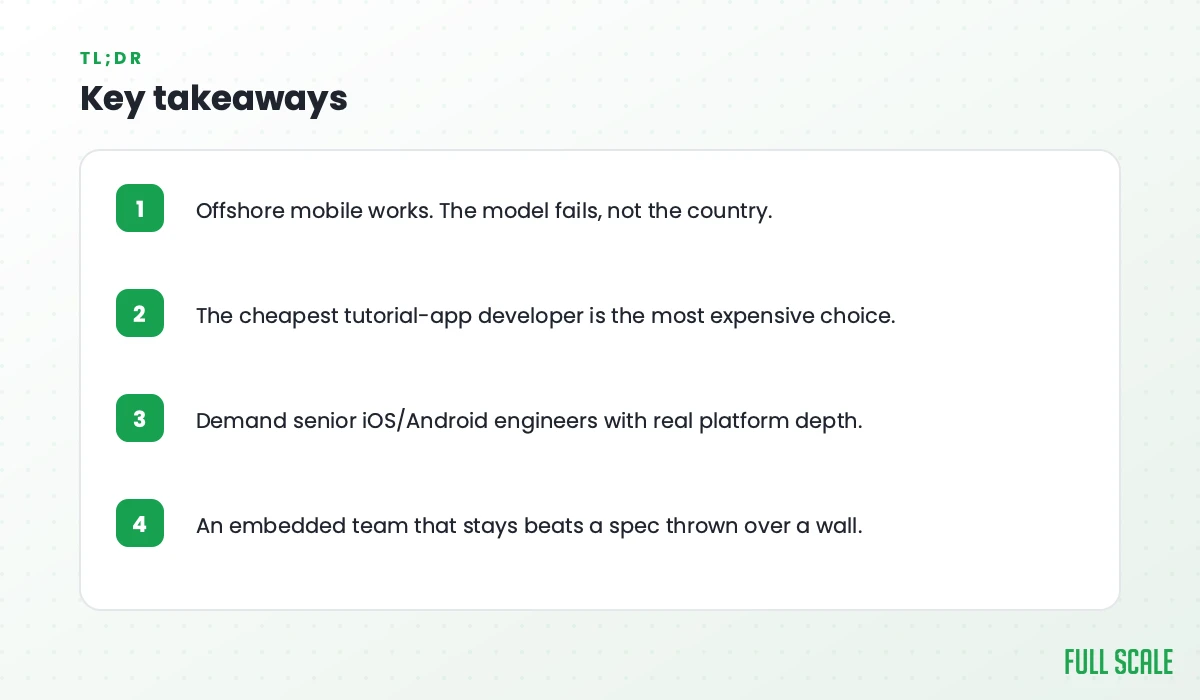
The failure mode I’ve seen more than any other in offshore mobile development isn’t a bad developer. It’s a bad engagement model.
Project outsourcing puts layers between you and the developers building your app. Your requirements pass through account managers, project managers, and team leads before reaching the engineer writing your Swift or Kotlin. Mobile app architecture decisions like navigation patterns, state management, app lifecycle handling, push notification behavior, and App Store and Google Play submission requirements all require real context. The telephone game strips that context out, and you get an APK or IPA that runs and doesn’t serve your users.
Direct integration / staff augmentation means your offshore mobile developers are on your team. They’re in your Slack, in your Xcode and Android Studio projects, in your code review queue. They work on your roadmap continuously. Full Scale handles payroll, HR, workspace, and equipment in the Philippines. You handle technical direction.
| Factor | Project Outsourcing | Direct Integration (Full Scale) |
|---|---|---|
| Architecture context | Filtered through layers | Discussed directly with your team |
| Platform-specific knowledge | Tested by vendor’s standards | Tested by our 5-stage process |
| Store submission knowledge | Often absent | Tested explicitly in vetting |
| Annual developer turnover | ~40% | ~7% (93% retention) |
| Start time | 4-12 weeks | 7-14 days |
The staff augmentation vs. outsourcing distinction is the real decision being made, regardless of how companies frame it when they start searching.
The Platform Depth Trap
“Mobile developer” isn’t specific enough to be a useful job description. Mobile app development in 2026 spans four distinct platforms with different languages, frameworks, toolchains, and store requirements. This is one of the common offshore software development challenges that generic offshore guides miss entirely:
- Native iOS: Swift + SwiftUI (or UIKit for legacy), Xcode, App Store Connect, TestFlight
- Native Android: Kotlin + Jetpack Compose (or XML Views for legacy), Android Studio, Google Play Console
- Flutter: Dart, single codebase for iOS + Android + web, Firebase integration common
- React Native: JavaScript/TypeScript, React conventions on native UI components, Expo or bare workflow
A developer who’s strong in one of these is not automatically strong in the others. The mental models differ. The toolchains differ. The store submission processes differ. And the specific failure modes differ:
- An iOS developer who “also does Android” may not understand Kotlin Coroutines or Jetpack Compose
- A React Native developer may not understand native module bridging or performance optimization at the native layer
- A Flutter developer may have never navigated App Store review or Google Play’s Data Safety form
Our vetting process tests for the specific platform the client needs, not generic “mobile” experience. That starts at the resume screen: we verify that years claimed in a specific platform are backed by published apps, real GitHub code, and specific architectural experience in that platform’s conventions.
The 7 Reasons Offshore Mobile App Projects Fail
Reason 1: Hiring generic “mobile developers”
The most expensive offshore mobile mistake is treating mobile development as a single skill set. A developer who learned iOS in 2019 and “also does React Native” is almost always strong in one and weak in the other.
Before hiring any offshore mobile team, answer: what platform(s) are you actually building for? Native iOS for Apple platform depth? Native Android app development for Android-first markets? Flutter for cross-platform with a single Dart codebase? React Native for JavaScript-familiar teams who need cross-platform? The answer determines the vetting criteria, the architecture decisions, and the failure modes to watch for. If Android is the focus, our guide to offshore Android developers covers the platform-specific playbook.
Reason 2: Cheapshoring mobile development
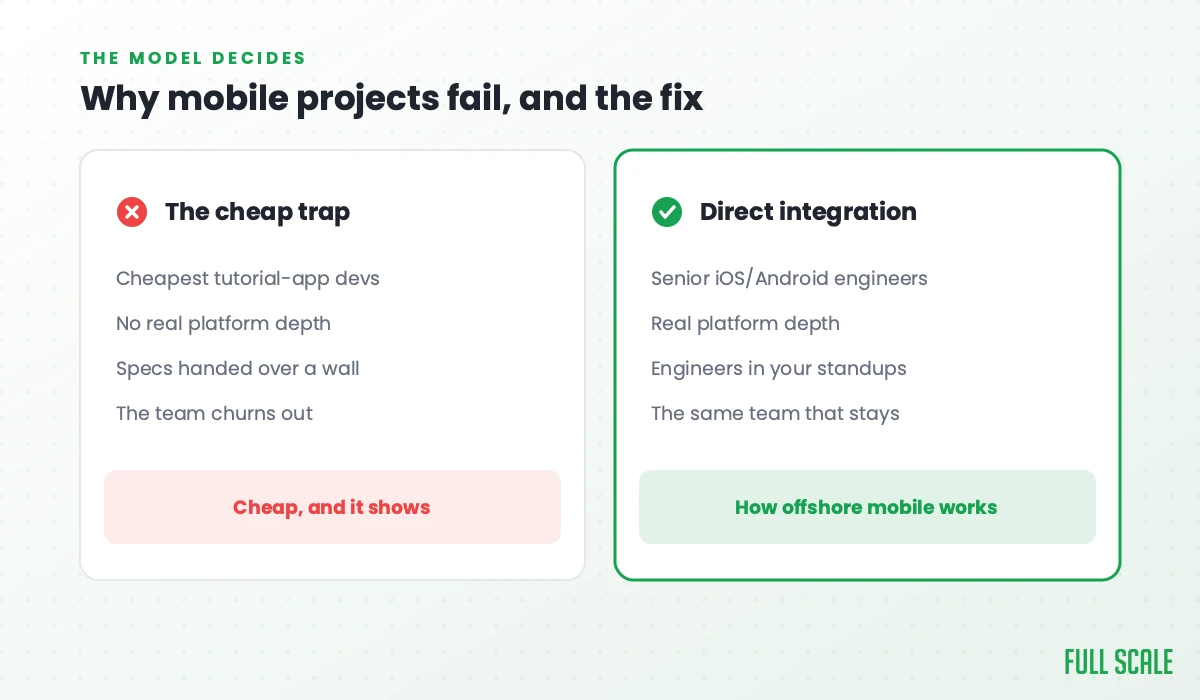
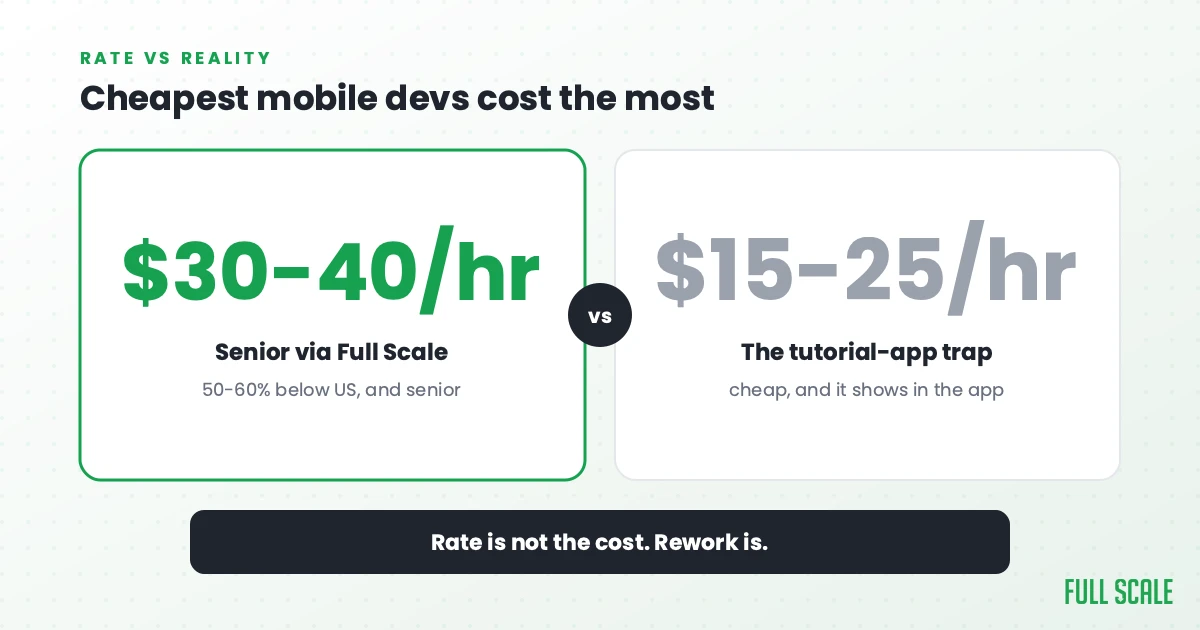
I call this cheapshoring: offshoring for cost alone. The offshore mobile market at $15-$25/hour is large and full of developers who built tutorial apps in 2020 and haven’t kept current with SwiftUI, Compose, Flutter 3, or React Native’s New Architecture. These developers produce apps that work on their test device and fail in production under real conditions.
Senior offshore mobile developers at Full Scale cost $30-$40/hour, still 50-60% below the all-in US equivalent. The quality difference is not a matter of degree. It’s a different product entirely.
Deloitte’s 2024 Global Outsourcing Survey found cost fell from 70% to 34% as the primary outsourcing driver between 2020 and 2024. Mobile development is where that lesson is learned hardest, because cheapshored apps are judged publicly by App Store and Google Play ratings.
Reason 3: No app store knowledge in the team
Both the App Store and Google Play have submission requirements, review processes, and rejection criteria that many offshore developers have never navigated personally. The App Store’s review guidelines, privacy manifest requirements, and App Review process. Google Play’s target API level compliance, Data Safety section, and staged rollout tooling. App signing and certificate management for both.
Developers who’ve written mobile code but never submitted an app to production have knowledge gaps that don’t show up until you try to ship.
Reason 4: Cross-platform chosen for the wrong reason
Flutter and React Native are excellent frameworks, but they’re often chosen offshore for the wrong reason: one team, lower cost, faster development. The reality is more nuanced. For apps with heavy native integrations (Bluetooth, NFC, camera, hardware APIs, ARKit/ARCore), native is usually better. For apps with complex animations or platform-specific UX conventions that users expect, native often delivers a better result.
We help clients think through this decision before placing any developer. The wrong platform choice early creates expensive architectural debt.
Reason 5: Mobile-specific architecture handled wrong by project shops
Mobile architecture involves decisions that are different from web backend or frontend development: navigation patterns, state persistence across app lifecycle events, push notification handling, background processing, offline-first data sync, deep linking, and the specific ways each platform handles app suspension and termination.
Project shops making these decisions without understanding your product produce apps where the architecture is correct for a demo and wrong for production use under real conditions.
Reason 6: Testing not mobile-realistic
Mobile QA is different from web QA. Device fragmentation (Android), OS version support floors, real network conditions (3G, airplane mode recovery), different screen sizes, hardware API behavior variations across manufacturers. Developers who test on one simulator and call it done ship apps that fail on real devices in your users’ hands.
Reason 7: No long-term commitment to a mobile codebase
Mobile codebases require ongoing maintenance: OS version updates, API deprecations, store policy changes, security patches. Developers who’ve been in your codebase for 18 months understand its architecture in ways a replacement never will. Our 93% annual developer retention means the mobile engineers who know your app’s lifecycle handling and navigation patterns stay.
The Full Scale Direct Integration Model for Mobile
Your offshore mobile developers are in your Slack, in your Xcode workspace or Android Studio project, in your code review queue. They follow your architecture patterns, your naming conventions, your testing standards.
Full Scale handles Philippines-side payroll, benefits, HR, workspace, and background checks (more thorough than US standard). You handle all technical direction.
AMC Theatres: consumer-scale mobile in production
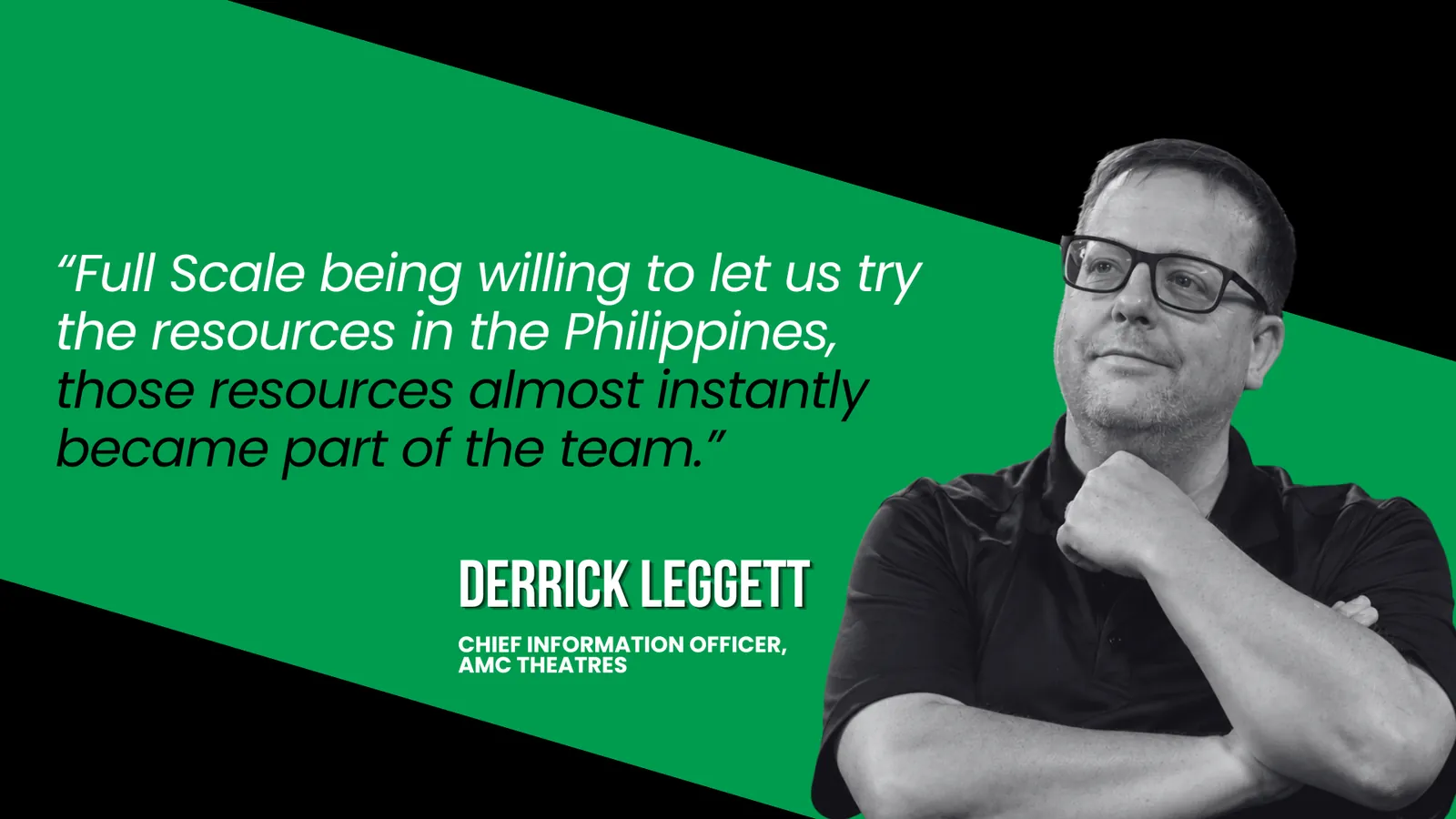
Derrick Leggett, CIO of AMC Theatres: “It’s a fully integrated team. It’s just some of the people happen to be living in the Philippines.”
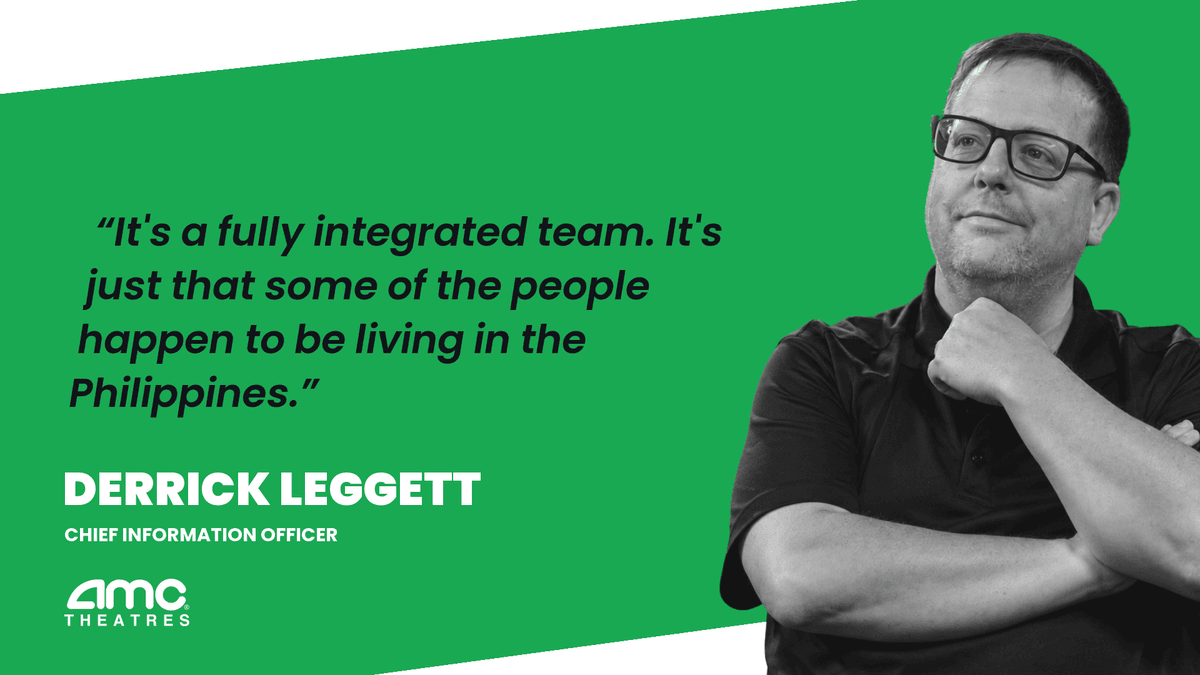
AMC’s consumer-facing mobile apps (ticketing, the A-List subscription, Stubs loyalty) serve millions of users across iOS and Android. Full Scale developers are embedded in that engineering team as full AMC engineers, not contractors. That’s the AMC Theatres case study proof at consumer mobile scale.
Why 93% retention matters specifically in mobile
Mobile apps are living products. OS updates break things. API deprecations require refactoring. New hardware capabilities create opportunities. New store requirements demand updates. The developers who understand your app’s architecture, your push notification setup, your deep linking logic, and your App Store history are worth protecting. High turnover in a mobile team is expensive in ways that are invisible until you need the institutional knowledge and it’s gone.
Our developer retention strategies and 93% annual retention are the foundation of long-term mobile team performance.
The 5-Stage Vetting Process: Finding Senior Mobile Engineers
fewer than 3% of applicants make it through. Here’s what separates the ones who do.
Stage 1: Resume and portfolio screening (55% rejected)
What we look for per platform:
iOS: Swift (not Objective-C-primary), SwiftUI or UIKit depth, published App Store apps, evidence of architecture experience (MVVM, Clean Architecture, Combine/async-await patterns), Xcode and TestFlight experience.
Android: Kotlin (not Java-primary), Jetpack Compose or XML Views depth, Google Play published apps, MVVM/MVI architecture, Coroutines and Hilt experience.
Flutter: Dart fluency, real Flutter production apps (not tutorials), state management depth (Riverpod, Bloc, Provider), native plugin experience.
React Native: TypeScript-first React Native, New Architecture awareness, Expo vs. bare workflow judgment, native module experience where relevant.
Red flags across all platforms: tutorial apps as the portfolio, Java/Objective-C as the primary language with no Kotlin/Swift transition, no published apps.
Our mobile developer hiring process follows these standards across every engagement.
Pass rate: 45%
Stage 2: Technical assessment (40% rejected)
90 minutes. Platform-specific questions relevant to what the client needs.
Sample questions (iOS):
– “Walk me through how you handle app state when the system terminates your app in the background.”
– “Explain the difference between @StateObject and @ObservedObject in SwiftUI and when you use each.”
– “How would you implement offline-first data sync in a SwiftUI app?”
Sample questions (Android): – “Explain the Android activity lifecycle and what happens to your ViewModel when the user rotates the screen.” – “Walk me through a Jetpack Compose screen you’ve built — what was the hardest part of the state management?” – “How do you handle push notification deep linking in a multi-activity app?”
Sample questions (Flutter):
– “What’s the difference between StatefulWidget and StatelessWidget and when does the distinction matter?”
– “Walk me through how you’d implement platform-specific code in Flutter using a method channel.”
Cumulative pass rate: 27%
Stage 3: Live coding exercise (30% rejected)
Build a small mobile feature (a screen, a data flow, a native integration) under real conditions. We observe architecture decisions, error handling, testing approach, and how the developer communicates while building.
Cumulative pass rate: 19%
Stage 4: Code review and architecture discussion (20% rejected)
Review real code from their App Store or Play Store apps. “Walk me through the architecture of this screen.” “Why this navigation pattern?” “How did you handle background processing here?” “What would you do differently?”
Cumulative pass rate: 15%
Stage 5: Cultural fit and English proficiency (about 20% rejected)
The Philippines is the third-largest English-speaking country in the world. We still test communication directly. Clear technical communication is essential in mobile development where platform-specific bugs require precise description and reproduction steps.
Final pass rate: under 3%
Our skills assessment framework covers the underlying methodology for all platform types.
The 7-Day Integration Framework for Mobile Teams
Day 1: Environment and project access
Xcode or Android Studio setup, repository access, build configuration, simulator/device setup, TestFlight or internal testing track access. Goal: developer can build and run the app by end of Day 1.
Days 2-3: Architecture orientation and pairing
Walk through the navigation architecture. Explain the state management pattern. Review the networking layer. Pair on a small bug fix or UI adjustment. First PR submitted.
Days 4-5: First real feature
A scoped screen or flow from the actual backlog. Active code review with explicit feedback on platform conventions and architecture alignment.
Days 6-7: Process integration
Sprint planning or backlog grooming. Feedback session. 30-day expectations set.
Weeks 2-4: Ramp to full productivity
Mobile developers with proper architecture orientation hit full productivity in 3-4 weeks consistently.
The Real Cost of Offshore Mobile App Development
Senior offshore mobile developer at Full Scale: $30-$40/hour fully loaded. Annually: $62K-$83K. Full pricing at fullscale.io/pricing.
US equivalent: senior mobile developers earn $130K-$155K in base salary. With the 1.25-1.4× loaded-cost multiplier: $160K-$215K+ annually. Recruiting fees add 20-25% of first-year salary.
| Cost Factor | US Senior Mobile Dev (3 years) | Full Scale Offshore (3 years) | Savings |
|---|---|---|---|
| Compensation | $480K-$615K | $186K-$249K | $294K-$366K |
| Recruiting | $32K-$40K | $0 | $32K-$40K |
| Onboarding | $12K | $6K | $6K |
| Turnover | $80K-$120K | $0 | $80K-$120K |
| Total | $604K-$775K | $192K-$255K | $412K-$520K |
Our cost analysis for offshore development covers the full ROI model.
Which Mobile Projects Offshore Best
Established native apps with defined architecture
iOS apps with a working SwiftUI or UIKit architecture, Android apps with MVVM/MVI and Compose in place all offshore well. The patterns are established, the developer can be productive within a week, and the codebase communicates its own conventions.
Flutter apps with a single cross-platform codebase
Flutter’s single codebase model makes offshore particularly effective: one set of developers, one review process, one deployment pipeline. Strong offshore fit for apps targeting both iOS and Android with shared business logic and UI. When you have settled on Flutter, our Flutter app development services staff that codebase with developers who have shipped real production apps, not tutorials.
React Native apps for JavaScript-background teams
Teams with JavaScript/TypeScript expertise extending into mobile via React Native. Offshore React Native developers from Full Scale’s bench share the same TypeScript foundations as the web React team.
Legacy Objective-C or Java modernization
Large iOS apps still on Objective-C, or Android apps still on Java. Migration to Swift/SwiftUI or Kotlin/Compose requires both legacy platform knowledge and modern framework fluency. Same embedded-team model as legacy PHP or Node.js migration, with offshore developers working alongside your local team, migrating incrementally.
What doesn’t offshore as cleanly
Highly experimental apps where the UX is still being invented. Games with complex real-time rendering. Apps requiring constant hardware prototyping with physical devices. These need tight designer-developer-hardware co-location until patterns stabilize.
When Offshore Mobile App Development Makes Sense
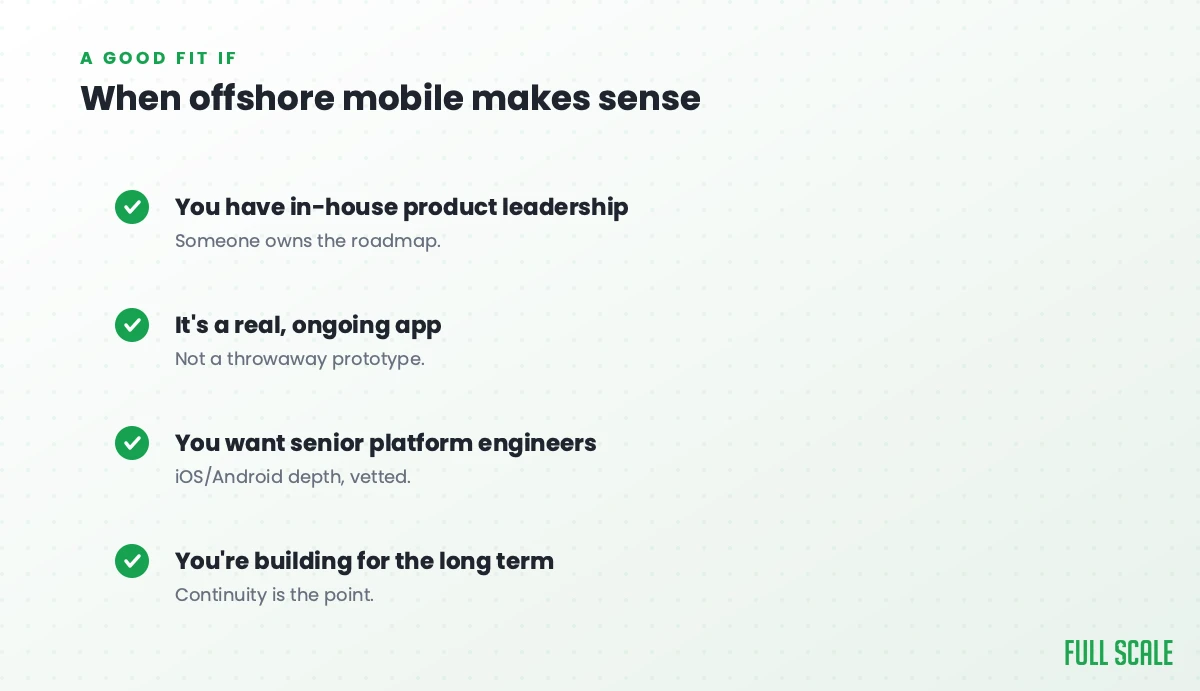
You have an established app and a feature roadmap. The architecture is defined. The patterns are set. Offshore mobile developers extend what exists.
You need platform-specific expertise you can’t hire locally fast enough. Senior iOS or Android developers take 60-90 days to hire in the US. Our timeline is 7-14 days.
You’re scaling a cross-platform codebase. Flutter or React Native teams benefit from offshore developers who know the specific cross-platform conventions, not just generic JavaScript or Dart developers.
You’re committed to long-term team building. The staff augmentation model was built for ongoing product development. The savings compound with retention.
When It Doesn’t Make Sense
Your app architecture is undefined. Define the navigation pattern, state management approach, and platform target with your core team before adding offshore capacity.
You want project outsourcing for ongoing development. Read our outsource mobile guide for when project outsourcing makes sense vs. when it consistently fails. Our offshore development best practices covers the broader model decision as well. For iOS-specific offshore work, see hire iOS developers from the same bench.
You’re in panic mode. Rushed mobile hiring produces worse results than rushed web hiring, because mobile mistakes are immediately visible to App Store and Play Store users.
Common Objections
“How do I know the platform depth is real?”
Our stage 2 assessment tests platform-specific architecture, not generic mobile questions. Stage 3 is a live coding exercise on the actual platform the client needs. Developers who’ve shipped real apps to the App Store or Play Store answer our vetting questions differently from those who’ve only built tutorial apps.
“What about the App Store and Google Play submission process?”
This is in our stage 2 assessment. We ask specifically about review guidelines, submission requirements, and the submission process. Developers who’ve shipped to production describe specific scenarios, like a rejection they had to fix or a guideline they had to interpret. Developers who haven’t give general answers.
“Time zones?”
The Philippines has 8+ hours of overlap with US morning hours. Your mobile developers are in standups and on Slack in real time during your workday.
“IP and security?”
Full Scale is a US company with US contracts, enforceable IP assignment, and NDAs. Background checks more thorough than US standard. See the offshore development due diligence checklist for the full vendor evaluation framework.
Why Full Scale for Offshore Mobile App Development
I built my first mobile app on a Compaq iPAQ before the iPhone existed. I shipped iOS and Android apps at Stackify. At every company since, I’ve been the founder hiring the mobile teams.
That twenty-plus years of mobile context shapes how Full Scale vets mobile developers, what we test for in each platform, and why we can tell the difference between a developer who’s shipped production apps and a developer who’s built tutorials.
Full Scale has placed hundreds of iOS, Android, Flutter, and React Native engineers in the Philippines. 93% annual retention. Consumer-scale mobile production at AMC Theatres. Browse our case studies from our clients to see how the model works across different product types and company sizes. Inc. 5000 five consecutive years. Great Place to Work Certified in the Philippines. Month-to-month contracts.
Schedule a consultation when you’re ready to build a mobile team that works like part of yours.
Not sure whether to outsource a mobile project or build an ongoing team? Read How to Outsource Mobile App Development Without Getting Burned.
Frequently asked questions
What is offshore mobile app development?
Offshore mobile app development is hiring iOS, Android, Flutter, or React Native engineers in another country to work on your mobile product. The model matters more than the location: staff augmentation (developers integrated directly into your team, using your architecture patterns and testing standards) produces 93% annual retention at Full Scale versus 40% typical of project outsourcing agencies.
How much does offshore mobile app development cost?
Senior offshore mobile developers at Full Scale cost $30-$40/hour fully loaded, or $62K-$83K annually. US senior mobile developers cost $130K-$155K in base salary, $160K-$215K+ fully loaded. That’s 50-65% in annual savings, compounding further with near-zero recruiting costs and 93% retention.
Which mobile platform should I use: native or cross-platform?
Native iOS and Android deliver the best performance and platform-specific UX, and are typically best for apps with complex native integrations (hardware APIs, AR, advanced camera), high-performance requirements, or apps where platform-specific UX expectations matter significantly. Flutter is the leading cross-platform option for teams that want a single Dart codebase for iOS and Android with good performance. React Native fits teams with JavaScript/TypeScript backgrounds extending into mobile. We help clients make this decision before placement based on their specific product requirements. For the deeper 2026 comparison, including Kotlin Multiplatform, .NET MAUI, and what AI changed about the decision, see the best mobile app development frameworks guide.
How do you verify app store submission experience in vetting?
Our stage 2 assessment asks specifically about App Store and Google Play submission: review guidelines experience, target API level compliance, Privacy Manifest requirements (iOS), Data Safety section (Android), app signing and certificate management, and staged rollout strategy. Developers who’ve submitted production apps describe specific scenarios. Developers who haven’t give general answers.
How long does it take to hire offshore mobile app developers?
7-14 days from consultation to a developer working in your mobile codebase. US mobile hiring at the senior level typically takes 60-90 days. That hiring gap is one of several mobile trends worth acting on this year, not just a staffing footnote. Full Scale maintains a pre-vetted bench of iOS, Android, Flutter, and React Native engineers in the Philippines ready to start.
Can offshore mobile developers handle both iOS and Android?
We place developers with deep expertise in a specific platform rather than generalists who “do both.” The strongest iOS/Android coverage is two developers, one per platform, who each own their platform’s architecture decisions. For cross-platform coverage from a single developer, Flutter or React Native with a developer who’s shipped both platforms via that framework is the right fit.