
How Much Does Offshore Software Development Cost? The Real Numbers

In this article
I’ve hired developers in Russia, Uruguay, Colombia, and the Philippines. Every time, the first number anyone wanted to talk about was the hourly rate.
The rate is the easiest part to quote and the worst part to plan around.
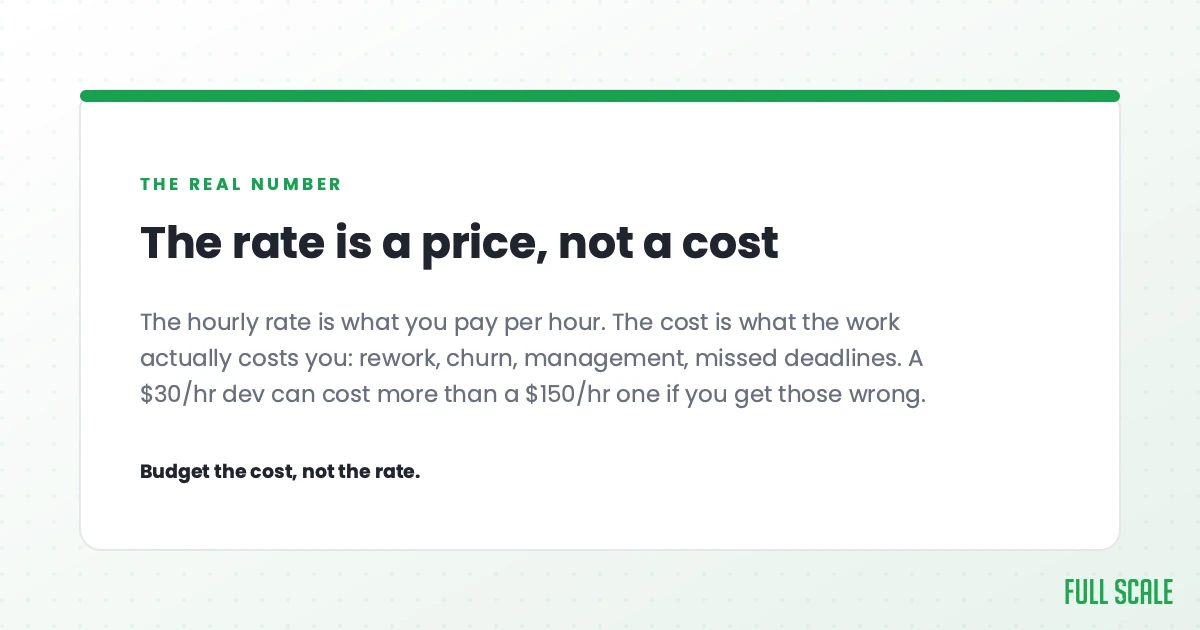
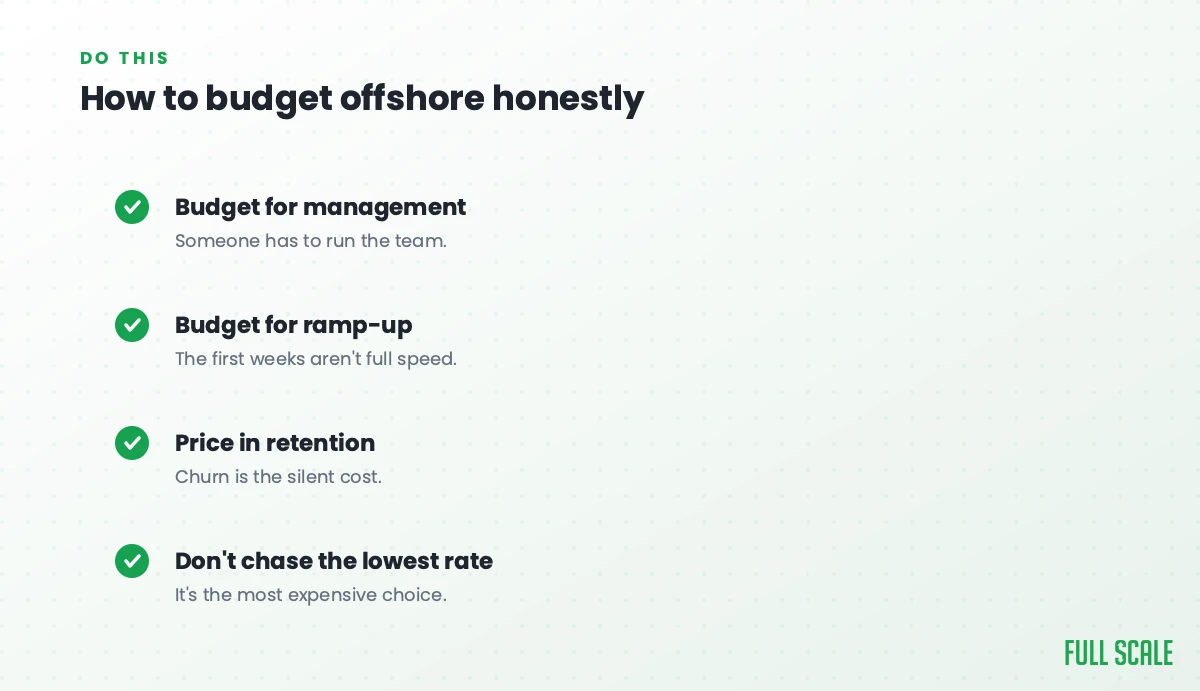
The hourly rate everyone quotes you is the cheapest line item on the whole bill. What actually decides whether offshore software development saves you money is everything the rate doesn’t show: the rework when a cheap hire builds the wrong thing, the hours your own people spend managing a vendor, and the cost of replacing someone who quits eight months in. Get those wrong and a $30-an-hour developer ends up costing more than the $150-an-hour one you were avoiding. It also helps to understand how much developers actually earn by location, since the rate you pay starts with a developer’s local salary.
The sticker price is exactly where most cost estimates go wrong.
QUICK ANSWER
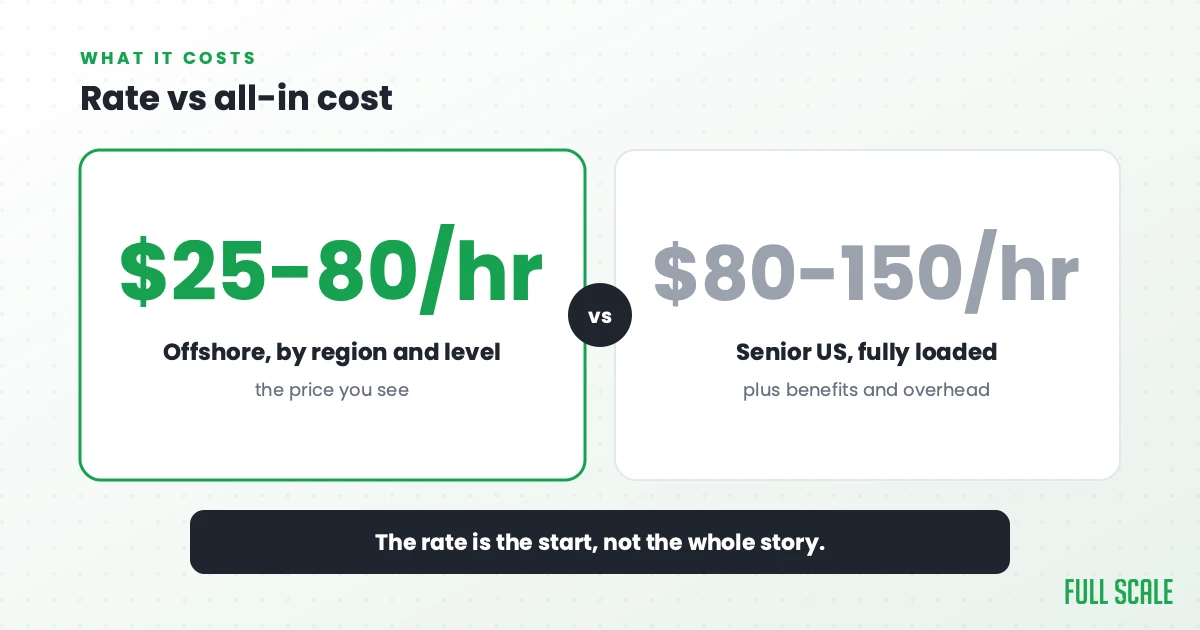
Offshore software development runs roughly $25 to $80 an hour depending on region and seniority, against $80 to $150 or more for a US developer. But the hourly rate is the smallest part of the real cost. The all-in number depends on rework, management overhead, and turnover. Done right, offshore runs 50 to 70 percent below US rates. Done as a race to the cheapest rate, the savings disappear into fixing bad work. For the market-wide numbers, see our IT staffing statistics for 2026.
The rate is a price, not a cost
When people ask what offshore software development costs, they want one number. Here’s the honest range of rates by region and seniority.
| Region | Typical hourly rate | Notes |
|---|---|---|
| United States (onshore) | $80–$150+ | The baseline you’re comparing against |
| Latin America (nearshore) | $40–$70 | Timezone overlap, higher than Asia |
| Eastern Europe | $35–$70 | Strong for complex engineering |
| Philippines | $25–$45 | Strong value for English-fluent senior talent |
| India | $25–$50 | Deep, large talent pool, wide quality range |
Those ranges are real, and they’re useful for a back-of-the-napkin estimate. If you want the full country-by-country breakdown, I’ve written a separate guide on offshore software development rates by country that goes deeper than a single table can.
But a rate is a price. A cost is what you actually pay to get working software shipped and kept alive.
Those are not the same number, and the gap between them is where most offshore budgets go wrong.
The reason the rate looks so good in the first place isn’t that offshore developers are worth less. It’s geography. As I’ve said before, the reason companies hire globally isn’t talent scarcity. It’s cost of living. My brother-in-law in the Philippines works at Jollibee, the country’s biggest fast-food chain, for about $1.25 an hour. My sister-in-law works as a virtual assistant for $5 an hour, four times his pay. A salary that looks low to an American is life-changing locally. That cost-of-living gap is the engine behind offshore savings, and it’s also why the cheap rate is honest rather than a trick.
What a US developer actually costs
To know whether offshore saves you anything, you need the right number on the other side of the comparison. Most people reach for the base salary, which badly undercounts what the engineer actually costs you. This matters even more for offshore backend development, where a bad early hire compounds into months of rework.
Start with base pay. The US Bureau of Labor Statistics puts the median software developer salary around $133,000 a year. A senior engineer with five or more years runs $150,000 to $185,000 in base salary alone.
Then add everything an employer actually pays on top of base. MIT’s Joseph Hadzima puts the fully-loaded cost of an employee at 1.25 to 1.4 times base salary once you count benefits, payroll taxes, equipment, recruiting, and overhead.
Run a senior engineer through that math:
- Base salary: $170,000
- Loaded multiplier: 1.3
- All-in annual cost: about $221,000
That’s the baseline that matters. It isn’t $170,000, and it definitely isn’t the hourly rate on the offer letter. A senior US developer costs you north of $200,000 a year all in. When you compare offshore against the salary instead of the loaded cost, you understate the savings before you’ve started.
The all-in offshore number
Now run the same honest accounting on the offshore side, using the Philippines as the example since it’s where Full Scale operates.
A good senior Filipino developer earns roughly $2,000 to $3,500 a month in pay. That’s developer pay, not the fully-loaded cost. On top of base, Philippine law requires a 13th-month bonus, one extra month of salary paid every December, which adds about 8.3 percent. There are statutory benefits, equipment, and the cost of recruiting and managing the person.
When you work with a partner, those costs get bundled into one rate. Full Scale’s billing rate for a senior engineer runs $30 to $40 an hour, and that number already includes recruiting, payroll, benefits, management, and the legal entity that employs the developer. There’s no separate line item to discover later. I break the Philippine pay bands down in detail in the post on software engineer salaries in the Philippines.
Put the two all-in numbers side by side and the gap is real: hiring global talent runs 50 to 70 percent below the all-in US cost for equivalent senior engineering. In round numbers, a five-developer senior team in the Philippines runs roughly $26,000 to $35,000 a month, all in, against $90,000 or more for the equivalent US team. If you want a per-project estimate by app type instead of a team run-rate, the software development cost calculator handles that math. That gap is the headline that makes offshore worth doing.
It’s also the number that’s easiest to lose.
Three costs that turn a cheap rate into an expensive project
The 50-to-80-percent savings is what offshore can deliver. Whether you actually keep it comes down to three costs that never show up on a rate card. Ranked by how much damage they do, here they are.
| Hidden cost | What it looks like | What controls it |
|---|---|---|
| Rework | Paying twice to build the same thing because the first version was wrong | Hiring for skill and judgment, not the lowest rate |
| Management overhead | Your senior people spending hours translating, correcting, and chasing a vendor | An integrated team instead of a walled-off project shop |
| Turnover | Losing people and paying to recruit and re-onboard replacements | Retention, because people who stay know your systems |
Rework is the cost of buying the cheapest rate
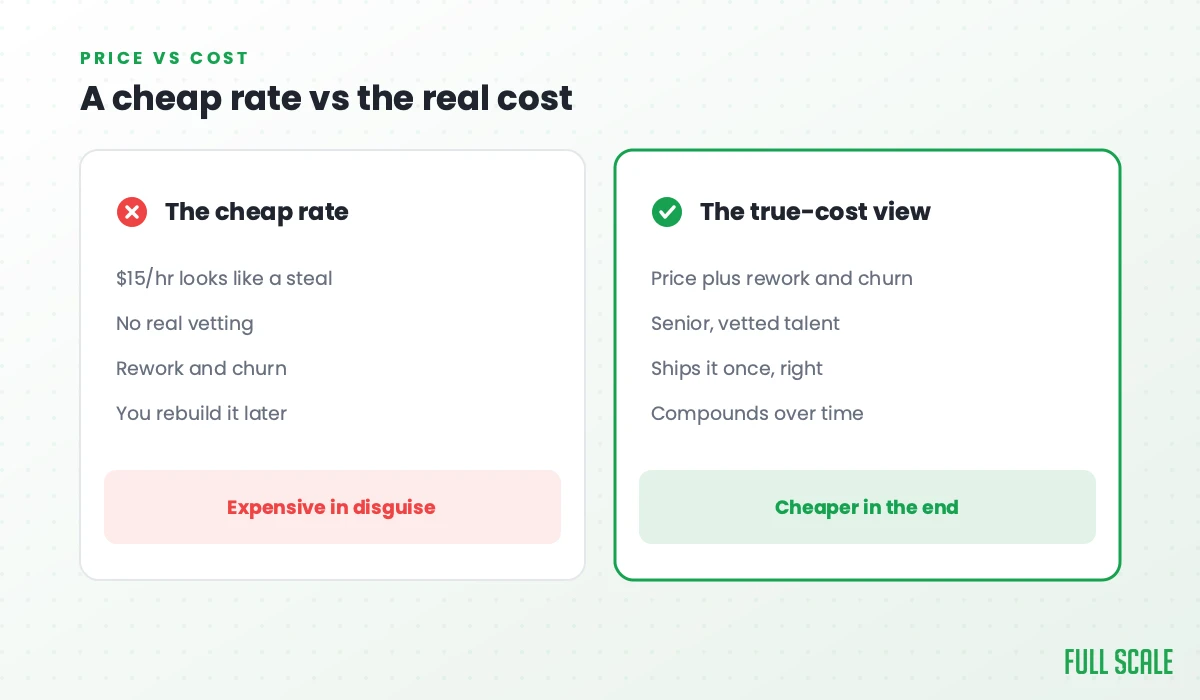
The single most expensive thing you can do is hire the cheapest developer you can find. I call it cheapshoring, and it’s the fastest way to blow up an offshore budget.
A developer at a rock-bottom rate who needs three tries to get a feature right, ships code your team has to rewrite, and misreads the requirement is not cheaper than a properly-paid senior engineer who gets it right the first time. You paid for the work twice and waited twice as long. It is the same point I make in my PHP framework comparison: the hiring decision matters more than the framework decision.
The cheapest developer is usually the most expensive one.
Rework doesn’t appear on any invoice, which is exactly why it wrecks budgets. It hides inside missed deadlines, re-opened tickets, and the senior engineer on your side who spends her afternoon fixing what came back. The rate looked like a saving right up until the rebuild bill arrived.
Management overhead is the cost of the wrong model
The second cost is the one your own people pay. Most offshore collaboration fails because somebody hands a pile of requirements to an outsourcing firm and expects a finished project to come back. In between sits a project manager you talk to while every actual developer hides behind that person.
That setup generates overhead constantly. You explain something, it gets relayed, it comes back slightly wrong, you explain it again. Your senior engineers turn into translators. The hours they spend managing the vendor are real money, and they rarely get counted against the offshore savings.
The fix is structural, not motivational. Offshore staff augmentation puts the developers directly on your team, in your standups, your Slack, and your code reviews, with no middleman. Yes, the Philippines is most of a workday ahead, but most of our clients run a four-to-six-hour daily overlap that covers standups and live code review, and some teams work full US hours when the work demands it. AMC Theatres runs its engineering this way. As their CIO Derrick Leggett puts it, “It’s a fully integrated team. It’s just some of the people happen to be living in the Philippines.” You can see how that works in the AMC case study.
When the offshore engineers are just your engineers, the translation tax shrinks to almost nothing. English fluency matters, cultural expectations matter, and whether a developer will speak up when they don’t understand something or push back when the spec is wrong matters more than the hourly rate on their invoice. That’s a hiring and integration question, not a pricing one.
There’s a cost here even when the model is right, and it’s the one people forget to budget. Someone still has to lead the team. You can hire ten developers at an offshore rate, but they need an engineering lead to set direction, own the architecture, and make the calls, and good engineering leadership is not cheap anywhere in the world.
This is the one cost you should never try to offshore away. The companies that hand over the leadership too, expecting the vendor to supply the vision, are the ones that quietly give the savings back. Budget for a lead, whether that’s your own senior engineer’s time or someone you hire to run the team. Affordable developers with nobody leading them turn into an expensive mess.
Turnover is the cost nobody budgets for
The third cost shows up six to twelve months in. A developer who knows your codebase, your quirks, and your product leaves. Now you’re paying to recruit a replacement, and your team is paying again to bring that person up to speed. Every departure resets the ramp.
This is where the Philippine outsourcing horror stories come from. Call-center attrition in the country runs 30 to 40 percent a year, the baseline people picture when they hear offshore, and it means a rotating cast of strangers touching your work. Software teams run very differently, which is the whole point.
Retention is the quiet cost-control lever, and almost nobody prices it in. Full Scale holds developer retention at 93 percent, and we’re Great Place to Work Certified in the Philippines two years running, with 95 percent of our team saying it’s a great place to work versus 65 percent at a typical company there. That’s not a culture brag for its own sake. People who stay know your systems, and continuity is cheaper than constant re-onboarding.
Cost is the wrong reason to go offshore
Here’s the part that surprises people. The smartest buyers I talk to aren’t doing this primarily to save money anymore.
Deloitte’s 2024 Global Outsourcing Survey found that cost reduction as the number-one reason to outsource fell from 70 percent in 2020 to 34 percent. Talent access and speed now rank as high or higher. The companies winning with offshore treat the savings as a bonus on top of access to senior engineers they couldn’t hire fast enough at home. You can see the same shift in these examples of offshoring from companies like Apple and JPMorgan, where talent drove the move more than the rate card.
That shift matters for how you budget. If your only goal is the lowest rate, you’ll optimize straight into the rework and turnover costs above. If your goal is good engineers at a sustainable cost, the savings come along for free and they actually stick.
AI sharpens the same point. I tell clients half-jokingly that we’re all paying developers to babysit AI now, to review what it generates, catch what it gets wrong, and steer it toward something useful. If anything, that widens the offshore advantage. Paying a US salary to supervise AI makes little sense when a senior offshore engineer does the same supervising for a fraction of the cost. As writing code gets cheaper, the value shifts to judgment and product thinking, which is exactly the part a cheap rate can’t buy.
How to budget an offshore engagement honestly
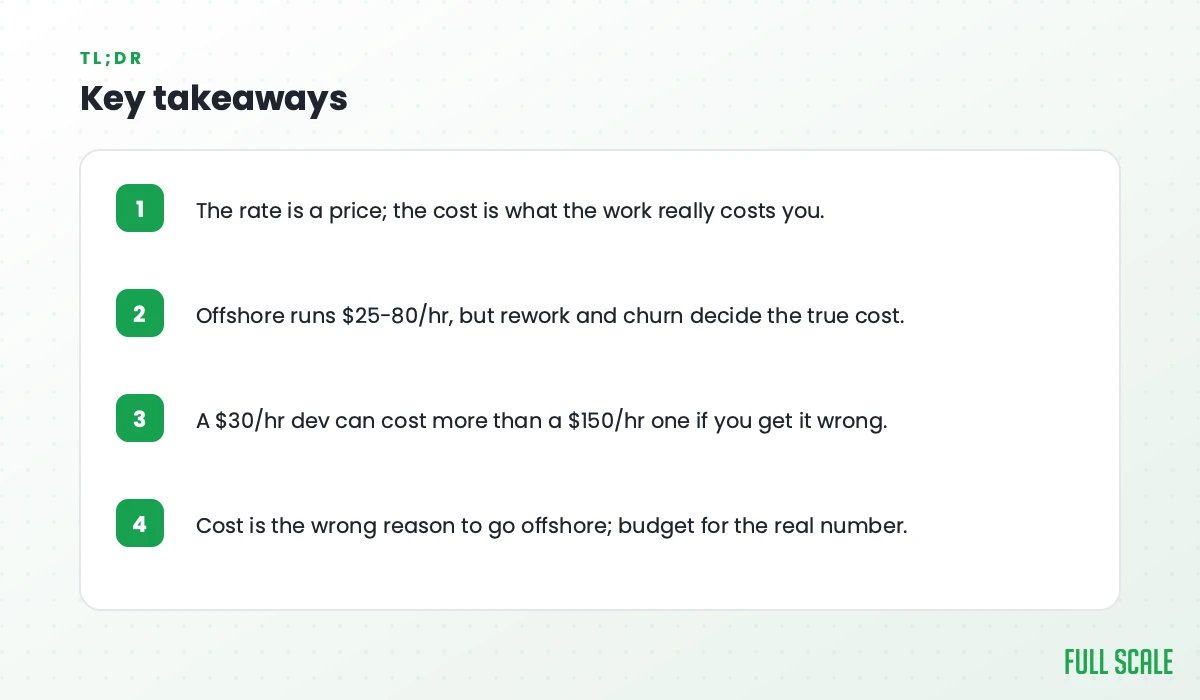
So how do you actually put a number on this before you commit? A few rules keep the estimate honest.
- Compare loaded cost to loaded cost. Put the all-in US figure (base times 1.25 to 1.4) against the all-in offshore rate, not salary against hourly rate. Anything else flatters one side.
- Budget for the hidden costs, not just the rate. Assume some rework, some turnover, and a real line item for engineering leadership, then choose the model and partner that minimize each. The ROI math behind that comparison is worth running properly.
- Match the model to the work. Fixed-price, time-and-materials, and dedicated-team pricing each carry the overrun risk differently. Long-term product work belongs with a dedicated development team, not a fixed-bid project shop, because the model drives the overhead more than the rate does.
- Run the levers, not just the location. Most of the savings on a mature engagement come from reducing rework and rerun, which I cover in how to reduce software development costs.
Offshore works much better when you hire talent to work directly for you on a long-term basis, not when you treat it as a one-time discount on a fixed scope. The number on the invoice is real, but it only tells you the price, never the full cost.
If you want senior engineers who land inside your team in about two weeks at a rate that already includes all of the above, Full Scale builds staff-augmented engineering teams and can hire developers in the Philippines for you without the cheapshoring tax. Hire good engineers, integrate them like your own, keep them for years, and the savings take care of themselves.
Frequently asked questions
How much does an offshore developer cost per hour?
Offshore developer rates run roughly $25 to $80 an hour depending on region and seniority, against $80 to $150 or more for a US developer. Senior engineers in the Philippines typically bill $30 to $40 an hour through a partner, with recruiting, payroll, and management already included in that rate.
What is the real cost of offshore software development beyond the hourly rate?
The hourly rate is the smallest part. The real cost includes rework when a cheap hire builds the wrong thing, the management hours your own team spends correcting and chasing a vendor, and the turnover cost of replacing developers who leave. These hidden costs decide whether the savings actually materialize.
How much can you save with offshore software development?
Done well, offshore software development runs 50 to 70 percent below US rates for equivalent senior engineering, driven by cost-of-living differences rather than skill. You keep that saving by avoiding rework and turnover, since chasing the absolute cheapest rate usually erases it.
Which offshore region offers the best value for software development?
The Philippines offers strong value for English-fluent senior talent at $25 to $45 an hour, with high English proficiency and cultural alignment with US teams. Eastern Europe and Latin America cost more but suit complex engineering or timezone overlap. The best region depends on your stack, timezone needs, and communication requirements more than on rate alone.
Why is the cheapest offshore developer often the most expensive choice?
Because you pay for the work twice. A developer who needs several tries to get a feature right, ships code your team has to rewrite, and misreads requirements costs more in rework and delay than a higher-rated engineer who gets it right the first time. The low rate is the bait; the rebuild is the bill. Paying for quality once beats paying for a redo, which is why it’s worth taking real care in how you hire offshore software developers instead of chasing the lowest number.